Wednesday, November 9, 2011

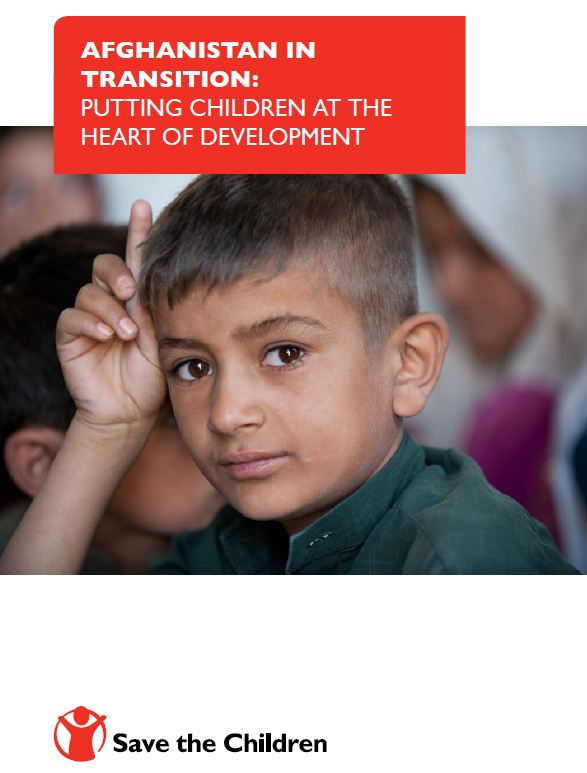
Afghanistan in Transition: Putting Children at the Heart of Development |STC


"2014 is not going to be like 1989."

— Staffan de Mistura, UN Security Council (UNSC), 6 July 2011, referring to the 2014 date by which “transition” is slated to be completed and the 1989 Soviet withdrawal from Afghanistan that led to the Afghan Civil War.


Overview
“This report will assess the record of the international community in its efforts to achieve development success in Afghanistan. The first section will assess the progress in the last 10 years through achievements made in key social sectors, such as health, education and child protection. The second section will look at the reasons that progress has been slow; arguing that geographic inequity in donor funding, lack of adequate funds to basic services and misappropriation of aid has stunted progress. Finally, the third section will look at the transition period and make recommendations regarding development and governance to both the Government of the Islamic Republic of Afghanistan (GIRoA) and the international community. It suggests a sustainable agenda for development in Afghanistan that focuses on a needs-based and community-led approach, promotes accountability to the Afghan people and donor public, and builds government capacity.”

Save the Children in Afghanistan
"Save the Children is an independent non-governmental, non-profit organisation that fights for a world in which every child attains the right to survival, protection, development and participation. Our mission is to inspire breakthroughs in the way the world treats children, and to achieve immediate and lasting change in their lives. We work in 120 countries worldwide.

Save the Children has worked in Afghanistan since 1976 and we currently reach over 3 million children per year through our programmes. We work directly in 9 provinces, providing protection, health and nutrition and education programming in the northern provinces of Faryab, Jawzjan, Sari Pul, Balkh and Samangan; the central province of Bamyan and Kabul; the eastern province of Nangahar, and in Kandahar and Uruzgan in the south. We work in a further 10 provinces through partners."

The authors are clear-eyed on the work ahead, noting that Afghanistan in 2001 represented an extraordinarily low base for development efforts.

Achievements in the Last Decade:

• There has been a 26 percent reduction in child mortality over the past decade.
• Today 85 percent of the population has access to primary health care, up from 9 percent in 2001.
• The number of Community Health Workers has increased to 20,000 (by the end of 2008), compared to 2,500 in 2004.
• Vaccine coverage for children against the childhood diseases of diphtheria, tetanus and whooping cough is at 83 percent, compared to just 31percent in 2000.
• In 10 years primary school access rates have jumped from 1 million to 7 million.
• A decade ago not a single formal girls’ school was functioning; now over 2.5 million girls are in school.
• The promotion and protection of child rights has improved. Afghanistan ratified the UN Convention on the Rights of the Child in 1994 and submitted its first report in 2008.


Afghanistan in 2011 | Key Facts

Children

550 — the number of children who die every day in Afghanistan of preventable causes, primarily of diarrhea and pneumonia

37,000 — the number of street working children in Kabul

1 million — the number of children in school in 2001

4 million — the number of children out of school, accounting for 42% of the school-age population

8.3 million — the number of children in school today

1 child in 5 dies before reaching his or her fifth birthday

57% — the number of Afghans under the age of 18 (68% under 25)

44 years — average life expectancy at birth

Funding

$300 — the cost of training one Community Health Worker, who can save thousands of children’s lives

$26.7bn — Aid (ODA) disbursed (2002-09)

$70bn — the total sum committed by the international community for security, governance and development in Afghanistan since the intervention in 2001

$259.8bn — Foreign military operations, peacekeeping and security related aid disbursed (2002-09)

97% — total aid equivalent to Afghanistan GDP

Millennium Development Goals

0 — the number of MDGs (of a total of 8) that Afghanistan is on-track to meet

13 years, beginning in 2001 — the length of time international community will have been ‘on the ground’ and allocating large-scale development funding by the time the military ‘transition’ is due to be completed

14 years, beginning in 2001 — the timescale set by the international community for the realisation of the Millennium Development Goals

Civilian Casualties

2,777 — the number of civilians killed during the conflict in 2010

1,462 — the number of civilians killed in first 6 months of 2011, an increase of 15% on the same period in the previous year

Paktika Province | Battle leaves 60-70 dead


The Associate Press is reporting that 60 to 70 people have been killed after an attack on a NATO/Afghan base along the border with Pakistan.

Mokhlis Afghan, a spokesman for the governor of Paktika, told the BBC:

"Between 60 and 70 insurgents attacked a joint NATO-Afghan National Security Forces (ANSF) base in Bermal district's Margha area on the border with the Durand line.

The insurgents were armed with heavy and light weapons. In retaliation, ANSF launched their own attack. After a fierce gun battle and air support from NATO, all of the insurgents were killed.

There were no civilian, NATO or ANSF casualties.”

Some Background -

Last month the New York Times ran a profile on the increasing violence along the border with Pakistan. At the time, these were my thoughts.
“It says something about the way the war is fought in Afghanistan when having your hands tied means you need to limit the number of high explosive weapons used and must refrain from using artillery shells with White Phosphorus.”

Reports on the fighting show there were no such restraints this time with US/NATO aircraft killing all of the insurgents.

Additional Resources: Civilian Casualties, Troop Levels.

Tuesday, November 8, 2011

Roadside Bomb Kills 11 in Badghis Province


The Associated Press is reporting a roadside bomb has killed 11 in northwestern Afghanistan. The Afghan Interior Ministry says “nine of the 11 killed were from one family, including six children and two women. Two policemen were also killed while three people - a 10-year-old child and two other policemen - were wounded.”
"A ministry statement on Tuesday says the bomb went off as a police vehicle was driving by Monday evening in Badghis province's Qadis district. The vehicle was part of a three-vehicle police convoy that had stopped shortly before to pick up a family that needed a ride into town."

Some Background: The violence does not take place in a vacuum.

The Guardian newspaper has a revealing interactive graphic that gives a sense of the 'cycle of violence'. The graphics document and detail US/NATO kill-capture operations throughout Afghanistan. It is based on research by the Afghanistan Analysts Network who went through and analyzed all of the NATO press releases.

Their findings clearly show that the vast majority of people killed or captured in the NATO actions were civilians. Not Taliban leaders and facilitators.

*****

From the Report | In Their Own Words

From 1 December 2009 to 30 September 2011, ISAF press releases reported a total of 3,157 incidents.

Of that there were 2,365 capture‐or‐kill raids.
3,873 individuals were killed.
7,146 detained.

Of that 174 ‘leaders’ were killed and 501 detained.
25 ‘facilitators’ were killed and 423 detained.

The number of ‘leaders’ and ‘facilitators’ killed equals approximately 5% of the total deaths.

The number of ‘leaders’ and ‘facilitators’ detained equals approximately 13% of the total detentions.

*****

Here are the specific figures for US/NATO attacks in Badghis Province.

Badghis
Total Operations: 31
Kills: 140
Kill/Capture (KC) Raids: 18

Kills in KC Raids: 33
Captures in KC Raids: 43
Ratio, kill to capture: 2.979

Friday, November 4, 2011

The Drone War in Pakistan

"Signature strikes target groups of men believed to be militants associated with terrorist groups, but whose identities aren't always known. The bulk of CIA's drone strikes are signature strikes.

...Signature strikes were first used under former President George W. Bush. His administration began arming unmanned aircraft to hunt al Qaeda leaders in Afghanistan immediately after the Sept. 11 attacks. As al Qaeda militants fled to Pakistan, the CIA began a secret drone program there, with quiet backing from Islamabad."


This Wall Street Journal article outlines the struggle behind the scenes over the undeclared CIA drone war in Pakistan. The battle is not over the covert use of drones, but the number of people being killed.

“The Central Intelligence Agency has made a series of secret concessions in its drone campaign after military and diplomatic officials complained large strikes were damaging the fragile U.S. relationship with Pakistan.

The covert drones are credited with killing hundreds of suspected militants, and few U.S. officials have publicly criticized the campaign, or its rapid expansion under President Barack Obama. Behind the scenes, however, many key U.S. military and State Department officials demanded more-selective strikes. That pitted them against CIA brass who want a free hand to pursue suspected militants.”

On Thursday the NYT’s ran a powerful piece on the impact of CIA war in Pakistan.

For Our Allies, Death From Above
By CLIVE STAFFORD SMITH
"LAST Friday, I took part in an unusual meeting in Pakistan’s capital, Islamabad.

The meeting had been organized so that Pashtun tribal elders who lived along the Pakistani-Afghan frontier could meet with Westerners for the first time to offer their perspectives on the shadowy drone war being waged by the Central Intelligence Agency in their region. Twenty men came to air their views; some brought their young sons along to experience this rare interaction with Americans. In all, 60 villagers made the journey.

The meeting was organized as a traditional jirga. In Pashtun culture, a jirga acts as both a parliament and a courtroom: it is the time-honored way in which Pashtuns have tried to establish rules and settle differences amicably with those who they feel have wronged them.

On the night before the meeting, we had a dinner, to break the ice. During the meal, I met a boy named Tariq Aziz. He was 16. As we ate, the stern, bearded faces all around me slowly melted into smiles. Tariq smiled much sooner; he was too young to boast much facial hair, and too young to have learned to hate.

The next day, the jirga lasted several hours. I had a translator, but the gist of each man’s speech was clear. American drones would circle their homes all day before unleashing Hellfire missiles, often in the dark hours between midnight and dawn. Death lurked everywhere around them.

When it was my turn to speak, I mentioned the official American position: that these were precision strikes and no innocent civilian had been killed in 15 months. My comment was met with snorts of derision.

I told the elders that the only way to convince the American people of their suffering was to accumulate physical proof that civilians had been killed. Three of the men, at considerable personal risk, had collected the detritus of half a dozen missiles; they had taken 100 pictures of the carnage.

In one instance, they matched missile fragments with a photograph of a dead child, killed in August 2010 during the C.I.A.’s period of supposed infallibility. This made their grievances much more tangible.

Collecting evidence is a dangerous business. The drones are not the only enemy. The Pakistani military has sealed the area off from journalists, so the truth is hard to come by. One man investigating drone strikes that killed civilians was captured by the Taliban and held for 63 days on suspicion of spying for the United States.

At the end of the day, Tariq stepped forward. He volunteered to gather proof if it would help to protect his family from future harm. We told him to think about it some more before moving forward; if he carried a camera he might attract the hostility of the extremists.

But the militants never had the chance to harm him. On Monday, he was killed by a C.I.A. drone strike, along with his 12-year-old cousin, Waheed Khan. The two of them had been dispatched, with Tariq driving, to pick up their aunt and bring her home to the village of Norak, when their short lives were ended by a Hellfire missile.

My mistake had been to see the drone war in Waziristan in terms of abstract legal theory — as a blatantly illegal invasion of Pakistan’s sovereignty, akin to President Richard M. Nixon’s bombing of Cambodia in 1970.

But now, the issue has suddenly become very real and personal. Tariq was a good kid, and courageous. My warm hand recently touched his in friendship; yet, within three days, his would be cold in death, the rigor mortis inflicted by my government.

And Tariq’s extended family, so recently hoping to be our allies for peace, has now been ripped apart by an American missile — most likely making any effort we make at reconciliation futile."

Clive Stafford Smith, an American lawyer, is the director of Reprieve, an organization that advocates for prisoners’ rights.

For more details about Reprieve, visit this post.

Thursday, November 3, 2011

National Youth Video Festival | If I Had a Trillion Dollars

No we Can’t - $1 Trillion and Counting

AFSC, BAY-Peace, Met West High School, Emiliano Zapata Street Academy


The Trillion Dollar Question

The Village of Arts & Humanities, Philadelphia, PA


One of the most exciting projects we worked on last year was the If I Had a Trillion Dollars Youth Video contest. The responses were so compelling - two of my favorites are above - that we decided to have another. We are again partnering with the National Priorities Project (NPP).

This year will end with a big festival celebration from 7-10 April 2012 in Washington DC. AFSC and NPP will host a youth leadership conference and organize film screenings for members of Congress. There will also be community events.

Please take a minute to forward this invitation. There is still plenty of time, but videos must be received by 15 January 2012.

What Would Youth Do With $1 Trillion?

Some ideas for outreach and groups that participated last year.

Teachers and school video clubs
Community groups
Your kids, their friends
Faith communities
Occupy communities

The National Youth Video Festival asks young people to speak out on the federal budget and to consider:

The nearly $1 trillion spent every year on the US military.
The more than $1 trillion spent on the wars in Iraq and Afghanistan.
The more than $1 trillion in tax cuts for the wealthiest Americans.

Wednesday, November 2, 2011

Windows and Mirrors | Next Week | KS and MO

After three action-packed weeks in San Francisco, the traveling murals are now being set up in Kansas and Missouri.

12 November - 30 December
KCMO Central Library, Kansas
Johnson County Library, MO

In San Francisco the murals were divided between the University of San Francisco and the Islamic Cultural Center of Northern California. For the next exhibit, they will again be divided between public libraries.

Check out the exciting events that are planned. They include a forum for youth voices, AFSC staff, Afghan activists, veteran peacemakers and an evening with Kathy Kelly.


Mural Image: What's Left of Kabul

Created by Guilford College Community and Hanna Swenson, Courtney Mandeville and Layth Awartani


If you have any friends or family in the area, please share this link.


KCMO Central Library
(Exhibit Opens November 12)
14 West 10th St.
Kansas City, MO

KCMO Central Library Hours:
Monday-Wednesday: 9am-9pm
Thursday: 9am-6pm
Friday: 9am-5pm
Saturday: 10am-5pm
Sunday: 1pm-5pm


Johnson County Central Resource Library
(Exhibit Opens November 19)
9875 W. 87th St.
Overland Park, KS

Johnson County Central Resource Library Hours:
Monday-Thursday: 9am-9pm
Friday: 9am-6pm
Saturday: 9am-5pm
Sunday: 1pm-5pm

*******************
KCMO Central Library
*******************

Sunday 13 November

Reception | 1 PM
Mike Ferner | 2-3 PM
A Veteran Reflects on the Afghan Windows and Mirrors Exhibit

Sunday 11 December 2 PM:

Kathy Kelly
Courage for Peace: Perspectives from Afghanistan
Kathy is the co-coordinator of Voices for Creative Nonviolence

*************************************
Johnson County Central Resource Library
************************************

Saturday 19 November

Reception | 1:30 PM
KC Area Youth Reflections on Afghan War | 2:00 PM
Peter Lems | Afghanistan: What's Next?

Sunday 4 December 2 PM

Suraya Sadeed
Director, Help the Afghan Children
Forbidden Lesson in a Kabul Guesthouse (book)


*****************
Speaker Background
*****************


Mike Ferner

Mike served two terms on Toledo City Council, organized for the public employees’ union, AFSCME, and worked as Communications Director for the Farm Labor Organizing Committee (FLOC), and for the Program on Corporations, Law & Democracy. He traveled to Iraq twice, with a Voices in the Wilderness delegation just prior to the U.S. invasion in 2003, and in 2004 for two months as a freelance writer. His book about those trips, Inside the Red Zone: A Veteran For Peace Reports from Iraq, (Praeger) was released in September, 2006, days before Mike was released from two months house arrest for painting “Troops Out Now!” on a highway overpass. He has been arrested several times for protesting the war in Iraq, including disrupting a Congressional hearing. He served as a Navy Hospital Corpsman during Vietnam, taking care of hundreds of wounded soldiers, was discharged as a conscientious objector and is on the national board of Veterans For Peace. Mike participated in a December 2010 delegation to Afghanistan.


Suraya Sadeed

Suraya was born and raised in Kabul, Afghanistan and immigrated to the United States after the Soviet Union invaded Afghanistan. In the US she became a successful business woman. During the height of the Afghan Civil War (1993), Suraya returned to Afghanistan and was shocked by the horrific conditions of children and the destruction of her homeland. That same year, she established a non-profit organization; Help the Afghan Children, Inc. Since then, Suraya's courageous efforts in providing humanitarian aid, medical care, education, and hope against seemingly insurmountable odds in some of the most inhospitable conditions imaginable, have directly benefited an estimated 1.7 million Afghan children and their families.

Help the Afghan Children was AFSC’s partner for our first delivery of funds to Afghanistan in 2001 to mitigate the suffering.

Kathleen Kelly

Kathy Kelly co-coordinates Voices for Creative Nonviolence, (www.vcnv.org) a campaign to end U.S. military and economic warfare. During late June and early July of 2011, Kelly, 58, was a passenger on the “Audacity to Hope” as part of the US Boat to Gaza project. She also attempted to reach Gaza by flying from Athens to Tel Aviv, as part of the Welcome to Palestine effort, but the Israeli government deported her back to Greece.

Since May 2010, she has visited Afghanistan four times with small delegations intent on learning more about conditions faced by ordinary people in Afghanistan, a country afflicted by three decades of warfare. Voices for Creative Nonviolence has been working closely with the Afghan Youth Peace Volunteers in search of non-military solutions to end the war.

In 2009, she lived in Gaza during the final days of the Operation Cast Lead bombing; later that year, Voices formed another small delegation to visit Pakistan, aiming to learn more about the effects of U.S. drone warfare on the civilian population and to better understand consequences of U.S. foreign policy in Pakistan. From 1996 – 2003, Voices activists formed 70 delegations that openly defied economic sanctions by bringing medicines to children and families in Iraq. Kathy and her companions lived in Baghdad throughout the 2003 “Shock and Awe” bombing.

She was sentenced to one year in federal prison for planting corn on nuclear missile silo sites (1988-89) and spent three months in prison, in 2004, for crossing the line at Fort Benning’s military training school. As a war tax refuser, she has refused payment of all forms of federal income tax since 1980.
She and her companions at the Voices home/office in Chicago believe that non-violence necessarily involves simplicity; service, sharing of resources and non-violent direct action in resistance to war and oppression.

Kathy organized and participated in the Spring 2011 delegation to Afghanistan to join the Afghan Youth Peace Volunteers in their campaign Live Without Wars.

Tuesday, November 1, 2011

UNHCR | Large Drop in Afghans Returning in 2011

There may be no greater indicator of conditions inside Afghanistan than the decisions of refugees to return or those displaced to leave.

Decades of war created an Afghan refugee crisis that has been one of the worlds largest. This vulnerable community has at times been seen as a destabilizing factor in Iran and Pakistan, the countries that host the largest number.

UNHCR has issued a statement that the number of Afghans returning from Pakistan has fallen by almost 60% since last year.

The lack of jobs, land, shelter, and violence from increased fighting in eastern Afghanistan, are the most frequently cited reasons for not returning.

In Iran, the number of Afghans returning is increasing due in part to a government decision cut off subsidies for food, fuel, and other commodities for both Iranian and Afghan families.

The reductions were part of government cost-cutting measures after the country was placed under US-led international sanction over its nuclear program.

An estimated 1.7 million Afghan remain as refugees in Pakistan with the majority living in the border provinces of Khyber Pakhtunkhwa and Balochistan. Due to weather, the UN does not seek to repatriate Afghans from Pakistan during the winter months.

About 4.6 million Afghans have returned since 2002, helped by the UNHCR and its government counterparts. In total, about 5.7 million have returned from Pakistan and Iran, roughly 25 per cent of the total population.

This link has more background, including reports and poetry.
Afghanistan 101 is a blog of the American Friends Service Committee
215-241-7000 · web@afsc.org