Showing posts with label Education. Show all posts

Wednesday, July 10, 2013

Update From Afghanistan | Zaher Wahab

Last week I received an update about life in Kabul from Zaher Wahab. Since retiring from teaching at Lewis and Clark College in Portland he has returned to Afghanistan to help build the education system.

He has designed two courses, 'Principles of Teaching and Learning' for teacher education faculty from the 17 four-year teacher training colleges throughout the country at Kabul Education University, and a graduate course on 'Strategic Leadership' at the Public Policy and Administration program at Kabul University to men and women working for the government, civil society and/or nongovernmental organizations.

He reports the students very capable, highly motivated, and extremely appreciative; though lacking academic preparation, from writing skills to the subjects they teach, to modern pedagogy.

That’s the inspiring news.

His comments on the broader impact of the on-going war are devastating and reveal a traumatized nation. As we read articles about the administration openness to a zero-option or complete withdrawal at the end of 2014, it is important to understand that for Afghan’s the war will not end with the removal of the last US soldier. The legacy will be long and painful with little hope of accountability from the U.S.

Here are some excerpts of what he has to say.

“At this point there are some 70,000 American and 40000 NATO troops, 110,000 contractors like Blackwater, now called academia and DynCorp, 500,000 Afghan security personnel-trained, equipped, paid for and supported by the US. all fighting some 20000 insurgents. Does this make sense?...

Washington still spends about $100 Billion/year in Afghanistan on the war. And it will spend $2 billion on destroying $7 billion worth of its military hardware here. Meanwhile, the Afghan government and army complain about lacking the necessary tools to fight with. All this when the Afghans, Congress, the American public, and the whole world wants the US/NATO out….

On the development front:

Half the population is hungry; half are un or underemployed; most are desperately poor; per capita income hovers around $450; a school teacher is paid 100-300$ a month, and professors from 300-800 per month. The cost of living in the cities is out of control. Meanwhile, the thousands of expats splurge $10-12 for a can of beer. 70% are illiterate; there are schools and universities with little to no education in them; the country imports 60% of the professionals; there really is no functioning government or economy, or even traffic lights in Kabul- a city of 5 million people and a million vehicles. Same roads I walked on as a child.

There is massive capital and human flight out of the country; Afghans constitute the largest refugee population and asylum seekers in the world; the government is ranked the most corrupt, and the country is the most unstable and dangerous in the world. At least five million school-age children are not in school, and half the schools have no buildings. Only 10% of the girls who start first grade, graduate from high school. At best, 20% of the teachers maybe qualified. Seven percent of the professors have doctorates, 35% MAs the rest just BA/BS. The country still has the highest child and maternal deaths in the world; it has the largest percentage of widows, orphans, street children and amputees in the world.

Only a third of the population has safe drinking water, and 20% electricity. The countries rivers flow out of the land, not a single damn has been built during the occupation, while USAID pays for electricity from Central Asia or generators. Violence, crime and corruption are out of control. There is no peace, safety or security anywhere for anyone, especially if you are a high government official, are part of the army-police-intelligence network, or a Westerner. The entire nation is traumatized. There are one and a half million drug addicts, including women and children, with little to no help. Drugs supply 90% of the world's heroin, constitute a third of the GDP, and are managed by individuals the US/NATO installed and protects.

There is massive pain and suffering throughout the country, while the ruling class is immersed in unbelievable privileges.

The buzz now is about 2014, and what the Americans, Pakistanis, Qataris and the Taliban are up to. Will the Karzai government really relinquish power by April 2014, as the Constitution says? Will civil/sectarian war start when the Americans/NATO leave/chased out? Will the country be partitioned amongst various groups? What about the common people? Who will provide the 97% government budget after 2014? How did the country become so dependent on foreigners? Why wasn't the country prepared for self-reliance, self-defense and self help? Those who know the answers are marginalized, silenced, or worse. People are very angry with some kind of demonstration/riot/protest weekly. The faculty and students shut Kabul University for three weeks recently. People have no faith or trust in and respect for the government or its foreign sponsors. And 70% of the people are under 25.

If I read things correctly, an 'Afghan Spring'- summer, or winter is just a matter of time. And I can hear people in the US wondering 'who lost Afghanistan?!”

Mural Art: What’s Left of Kabul
By: Guilford College Community and Hannah Swenson, Courtney Mandeville and Layth Awartani. Greensboro, NC
From : Windows and Mirrors: Reflections on the War in Afghanistan

Wednesday, March 7, 2012

Young Women for Change | Noorjahan Akbar

Noorjahan Akbar is a co-founder of Young Women for Change, an inspiring organization that works for gender equality in Afghanistan.

She has just been chosen as one of the recipients of the 2012 Women of Distinction Award by the National Conference for College Women Student Leaders.
"Born in Kabul, Afghanistan, in 1991, Noorjahan Akbar has had the rare opportunity of receiving an education, something not available to the majority of women in Afghanistan. She earned scholarships to attend two years of high school at the George School in Pennsylvania, and she is currently a sophomore at Dickinson College.

Akbar learned English and computer skills when her family moved to Peshawar, Pakistan, after the Taliban entered Afghanistan. In 2001, her family returned to Afghanistan and started an English-language center for about 400 women in the Qala-e-Fatullah region of Kabul.

At a very early age, Akbar started working with Radio Azadi (Radio Free Europe) as a writer for children’s programs. In the ensuing years, she worked as a writer and a translator at several organizations. Through her job at a German education program, she worked with children to write a book of six short stories for kids. The collection, which was printed and distributed in Afghanistan, inspired Voices for Hope, an effort focused on teaching children to write and think creatively. She later designed a program called Stories to Heal, which worked with 100 Afghan orphans on creative writing projects.

In summer 2011, Akbar co-founded Young Women for Change, an organization of volunteers who work for gender equality in Afghanistan. Since then, YWC has gained nonprofit status, formed a male advocacy group, organized monthly lectures on gender and women’s studies, collected books to build libraries in Kabul and Helmand, and began conducting research on street harassment in Kabul, thanks to a new grant."


Here is a link to their active facebook page.

Here is a previous story.

She published this article in the March 2011 issue of Friends Journal about a project to gather and record traditional Afghan music.

Here is a profile of her work at Dickinson College.

Wednesday, February 8, 2012

Profiles of Nonviolent Resistance | Maya Evans


In December Maya Evans was part of a peace delegation to Afghanistan. Below is a profile she had published in Peace News. Peace News is a grassroots peace and justice movement building magazine in the UK.

Forgiving the Taliban

In the morning we were visited by one of the female members of the Afghan Youth Peace Volunteers, Lena, a young, intelligent, outspoken Afghan woman who has just qualified as a teacher and has already taught in various schools inside Kabul.

Lena was very much anti-NATO intervention and felt that foreign involvement in Afghanistan was only bringing further violence and unrest. She also emphasised the importance of free state education for all, explaining that she could earn a very good wage working for private schools, but she preferred to work in government schools, educating the people of Afghanistan. She felt that providing she had food for lunch and dinner that was good enough for her.

We were then visited by Feda Mohammed, a former official in the ministry of education and now an education consultant. Over lunch, Feda, a slim, tall, middle-aged family man, dressed in a neat suit and tie, put across the opposing view to Lena. He was very much in favour of NATO and foreign intervention, his analysis was very black-and-white: Afghanistan could have either foreign occupation or the Taliban (a horrible prospect to most in Afghanistan, especially those who had experienced their previous reign). He viewed the killing of civilians by NATO as “collateral damage”, a necessary part of eradicating the Taliban, even if those deaths included his three sons.

There was a stony silence in the room.

AYPV Abduli, a 16-year-old Hazara boy from Bamiyan, whose father had been killed by the Taliban, was asked for his opinion. One of the most moving moments of my life then took place.

Abduli was silent for a while and then he quietly said: “If a Talib was in this room now, I know there is only one way forward to resolve the situation… forgiveness”.

The room fell silent.

I looked down and wept quietly. I wept for his pain and I wept for his strength and wisdom. I was astounded that such a young person, who had experienced one of the worst things a child could endure, had chosen the hardest path to walk. Without a doubt that moment will stay with me forever and whenever I weaken in my conviction to walk the path of nonviolence and forgiveness I will think of Abduli.

Click here for more stories about the Afghan Youth Peace Volunteers.

Maya also participated in a recent delegation to India with members of the Afghan Youth Peace Volunteers to India. Visit their inspiring travelogue here.

Tuesday, January 31, 2012

Kabul: A City at Work | Who is the Graffiti Artist?


Check out Kabul: A City At Work page.


Who is the Graffiti Artist?

I was born and raised in Iran and in the last 3 years of school I wanted to chose art as my major subject but I was told that as an Afghan I wasn’t allowed. So I studied accounting which was okay but a million miles away from painting.

When my family came back to Afghanistan I tried again and passed into the Faculty of Fine Arts at Kabul University. Art is such a part of my life that I don’t know what would happen if was not able to continue. It would be like having a piece cut out of me.

At present I work with a team of 10 Afghan artists called Roshd, meaning ‘growth’. I do Modern Art. It is something new and so Afghans are against it on principal. They say it’s a western imposition. I don’t see that it has anything to do with the West if the artist and artistic concept are Afghan. My interpretation of art is founded on the classical techniques and styles I was taught.

In December 2010 there was a graffiti workshop that was organized by Combat Communications. Until then, I didn’t know what graffiti was; I had seen some things on the walls in the city but it was advertising not art.I was used to working with paints on canvasses but when I used a spray can for the first time and worked on a big wall it was exciting and cool and such an achievement.

At first I didn’t know what to graffiti as the wall was so big and the spray cans took time to get used to but Chu was a really good teacher. I wanted to do something about women’s rights in Afghanistan and the burqa, but in an ironic way and take the idea of the burqa away from how we are used to seeing it.

But when I was working I had images of all the problems in Afghanistan and all the problems women have here. It was all in front of me, and I felt I wasn’t doing them justice. I worked on an image of a woman in burqa sitting on the ground and had made up a poem about her life. I did few others like her as I wanted to mix the modern style of my painting with their past life to show what kind of life women have in this age.

When I paint, I often paint fish covered with bubbles over their bodies it’s a conceptual idea I have created about not being free to express yourself.

I mean, if a fish opens its mouth, bubbles come out, right? And if its mouth is closed, there are no bubbles. So the bubbles I paint are the bubbles of things it wants to say but can’t. All the bubbles get stuck in its body like artistic ideas with no avenue for expression.

I haven’t been to many places to graffiti. One was the workshop and the other was at the Goethe Institute which is a secure and means I don’t get hassle on the streets, which as a girl, happens almost daily. Sadly It means I don’t get to practice that much so people are like, ‘How can you call yourself a graffiti artist if you can’t graffiti on buildings?’ But it’s just too dangerous to walk around on the streets. Once I went to the Russian Cultural Centre to graffiti and was so scared. It was dark and damp and I was afraid of stepping on a landmine or something.

I graffiti in my own way at home. I have photographs of old alleyways and the walls of Kabul and I graffiti the photograph. It is a comment on the restrictions of women in its own way.

In any case, I don’t think Afghan society is ready to accept graffiti as a form of art. The country has been in war for so long that most people are still pre-occupied with politics or just trying to stay alive.

But generally I only have one wish. I want to see Afghanistan vying with other countries in the art world. In Iran, if you mentioned Afghanistan people would think negative things. In the West, people say there is no art in Afghanistan but if only they came here, they could see what is developing, albeit very slowly. I personally think that art can be so useful for changing the situation of a society, it is part of the culture and culture has a role in representing a country. Everyone has to try as much as possible to rebuild the country, not just artists.

Wednesday, November 9, 2011

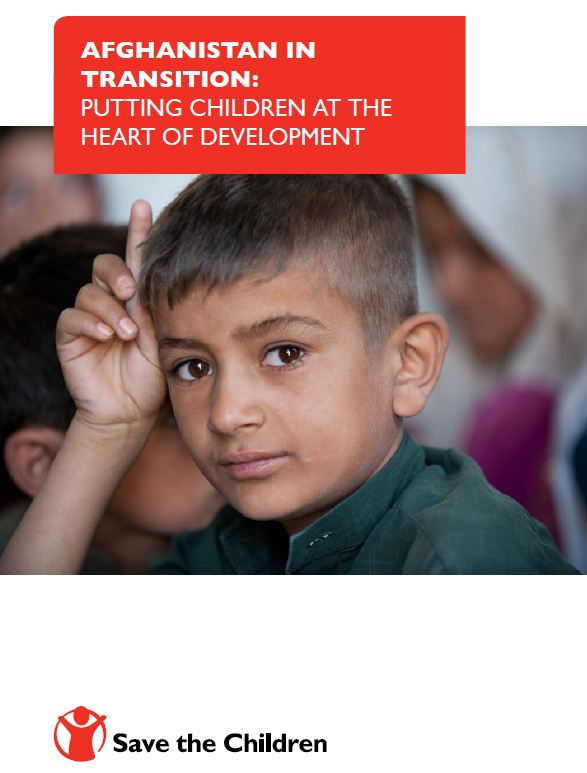
Afghanistan in Transition: Putting Children at the Heart of Development |STC


"2014 is not going to be like 1989."

— Staffan de Mistura, UN Security Council (UNSC), 6 July 2011, referring to the 2014 date by which “transition” is slated to be completed and the 1989 Soviet withdrawal from Afghanistan that led to the Afghan Civil War.


Overview
“This report will assess the record of the international community in its efforts to achieve development success in Afghanistan. The first section will assess the progress in the last 10 years through achievements made in key social sectors, such as health, education and child protection. The second section will look at the reasons that progress has been slow; arguing that geographic inequity in donor funding, lack of adequate funds to basic services and misappropriation of aid has stunted progress. Finally, the third section will look at the transition period and make recommendations regarding development and governance to both the Government of the Islamic Republic of Afghanistan (GIRoA) and the international community. It suggests a sustainable agenda for development in Afghanistan that focuses on a needs-based and community-led approach, promotes accountability to the Afghan people and donor public, and builds government capacity.”

Save the Children in Afghanistan
"Save the Children is an independent non-governmental, non-profit organisation that fights for a world in which every child attains the right to survival, protection, development and participation. Our mission is to inspire breakthroughs in the way the world treats children, and to achieve immediate and lasting change in their lives. We work in 120 countries worldwide.

Save the Children has worked in Afghanistan since 1976 and we currently reach over 3 million children per year through our programmes. We work directly in 9 provinces, providing protection, health and nutrition and education programming in the northern provinces of Faryab, Jawzjan, Sari Pul, Balkh and Samangan; the central province of Bamyan and Kabul; the eastern province of Nangahar, and in Kandahar and Uruzgan in the south. We work in a further 10 provinces through partners."

The authors are clear-eyed on the work ahead, noting that Afghanistan in 2001 represented an extraordinarily low base for development efforts.

Achievements in the Last Decade:

• There has been a 26 percent reduction in child mortality over the past decade.
• Today 85 percent of the population has access to primary health care, up from 9 percent in 2001.
• The number of Community Health Workers has increased to 20,000 (by the end of 2008), compared to 2,500 in 2004.
• Vaccine coverage for children against the childhood diseases of diphtheria, tetanus and whooping cough is at 83 percent, compared to just 31percent in 2000.
• In 10 years primary school access rates have jumped from 1 million to 7 million.
• A decade ago not a single formal girls’ school was functioning; now over 2.5 million girls are in school.
• The promotion and protection of child rights has improved. Afghanistan ratified the UN Convention on the Rights of the Child in 1994 and submitted its first report in 2008.


Afghanistan in 2011 | Key Facts

Children

550 — the number of children who die every day in Afghanistan of preventable causes, primarily of diarrhea and pneumonia

37,000 — the number of street working children in Kabul

1 million — the number of children in school in 2001

4 million — the number of children out of school, accounting for 42% of the school-age population

8.3 million — the number of children in school today

1 child in 5 dies before reaching his or her fifth birthday

57% — the number of Afghans under the age of 18 (68% under 25)

44 years — average life expectancy at birth

Funding

$300 — the cost of training one Community Health Worker, who can save thousands of children’s lives

$26.7bn — Aid (ODA) disbursed (2002-09)

$70bn — the total sum committed by the international community for security, governance and development in Afghanistan since the intervention in 2001

$259.8bn — Foreign military operations, peacekeeping and security related aid disbursed (2002-09)

97% — total aid equivalent to Afghanistan GDP

Millennium Development Goals

0 — the number of MDGs (of a total of 8) that Afghanistan is on-track to meet

13 years, beginning in 2001 — the length of time international community will have been ‘on the ground’ and allocating large-scale development funding by the time the military ‘transition’ is due to be completed

14 years, beginning in 2001 — the timescale set by the international community for the realisation of the Millennium Development Goals

Civilian Casualties

2,777 — the number of civilians killed during the conflict in 2010

1,462 — the number of civilians killed in first 6 months of 2011, an increase of 15% on the same period in the previous year

Thursday, June 16, 2011

Sizable and Sustained


Yesterday 27 U.S. Senators sent a letter to President Obama urging a sizable and sustained withdrawal of US forces from Afghanistan beginning next month. Nearly half the Senate Democratic Conference, including 10 committee chairmen signed the letter.

Sizable and sustained should also define the support international institutions and governments commit to help Afghans repair an education system battered from decades of war.

While officials hail progress on education vast challenges remain. Only half the country’s schools have the premises and teaching materials they need.

This story, Afghan Schools Short on Buildings and Books is about Kapisa, a province northeast of Kabul. The reporter, Maiwand Safi, has been trained by the Institute for War and Peace Reporting (IWPR).

“The deputy director of education in Kapisa, Abdul Rasul Safi, told IWPR that 78 of the 212 schools in the province had no premises of any kind.”

...


"When a Soviet-backed administration was in power in the 1980s, mujahedin groups often targeted schools that they believed were nests of communist ideology. Their capture of Kabul in 1992 produced an internecine conflict in which schools were looted and commandeered. Then came the Taleban, who allowed schools to reopen, but just for boys, and prescribed only a loose curriculum based largely around Islam.

Since 2001, international donors have injected large amounts of money into construction programmes, so that the education ministry now says that half the 14,100 schools in Afghanistan have the premises, laboratories, libraries and teaching materials and equipment they need.

Afghans flocked to send their children to school as soon as it became to be possible, although boys still out number girls six to four on the school rolls. But many feel let down by the continuing shortage of textbooks, trained and motivated teachers and basic classroom facilities.

Education ministry spokesman Abdul Sabur Ghofrani argues that while a great deal of progress has been made, the government cannot do everything at once.

With 7,000 schools still lacking buildings, he said, “The education ministry is using its development budget to build premises for 1,000 schools a year, and will continue to address this problem.”

One success highlighted is the growth of the teacher-training colleges. Addressed in a previous post from Zaher Wahab entitled Dispatch from Afghanistan | Ray’s of Hope.

Wednesday, June 15, 2011

Dispatch From Afghanistan | Rays of Hope

Zaher Wahab | Kabul | 11 June 2011

The role of education and Afghan strategies to strengthen institutions that support that right is a critical challenge: one that enjoys enormous popular support across the country.

Zaher Wahab, an Afghan professor who teaches at Lewis and Clark College in Portland spends four months each year working in Kabul.

This is the final dispatch for this year
.


Hope Against Hopelessness

Afghanistan evokes a litany of negatives in one’s mind such as: endless wars, brutal occupations, corruption, drugs, failed-state, fragile-state, narco-state, mafiocracy, crime syndicates, Blackwater, Drones, Predators, F16s, Human Terrain Teams, Female Engagement Teams, NGO’s, waste, fraud Chinook helicopters, psychological warfare, special operations forcer, night-raids, collateral damage, anguish ,treason, betrayals, Paetreaus, Obama, Hillary Clinton, Bagram, black holes, ,extreme poverty, child abuse, improvised explosive devices, suicide bombers, Taliban, NATO, crime and criminality, disaster capitalism, war profiteers, nepotism, the oppression of women, child labor, kill teams, white phosphorous, injustice, impunity, cultural invasion, deadly pollution, depleted uranium, traffic jams, amputees, countless beggars, child workers, economic invasion, child marriage, high suicide among young women, sectarianism, foreign subversion, lies, deception, and more.

Ray of Hope

But, here and there, there are signs of hope. For the last five years, I have been teaching in a master’s degree faculty development program designed to upgrade the knowledge, pedagogic skills, and professional dispositions of teacher education instructors from Afghanistan’s 18 four –year teacher training colleges. The program is funded by the US Agency for International Development, and implemented by the University of Massachusetts. The program is competitive and selective, and it maintains fairly high academic-professional standards. Each cohort consists of 11 men and 11 women, ages 24-43, representing the diversity in the country. We have graduated two cohorts thus far, and are currently working with two groups. Naturally, people come from different backgrounds, having amazing, diverse and/or tragic histories. Some have never been to the capital Kabul. Most have not touched a computer, and have never been on a plane. Some encounter academic difficulties. Many of the women have never sat next to a strange man, or spoken to one. Travel throught the country is fraught with danger. All are caught in Afghanistan’s endless civil, ethnic, sectarian, urban-rural, and/or imperialist wars and turmoil. Several have been touched by the country’s 35-year turmoil directly. All have been traumatized in one way or other. Most have families who must survive on $300 per month. Group members initially harbor fear, anxiety, uncertainty, suspicion, rivalries and distrust about each other. They feel overwhelmed, hopeless and angry about the condition of their wretched country.

But I have been amazed at the personal-professional progress, change and even transformation, among the participants. By the end of the four–semester program, they cooperate, help, respect, trust, like, and seek each other in academic-professional-personal matters. They overcome their fear, stereotypes, prejudices, distrust, sectarianism and identity politics. They begin to coalesce as a professional group and as one people, and talk about the country, the nation and their common humanity. Hardly anyone is ever late or absent; they do not take breaks; and they never whine about the academic rigor or the heavy work-load.They work very hard. By the end of the program, they develop excellent academic-intellectual skills. And they develop professional identities, and a sense of the teaching profession and its educational, sociopolitical, economic, cultural, and ethical role and responsibility toward their students and the ravaged country.

They are angry and impatient at the catastrophic conditions of the war-torn country, and they are determined to struggle for change, starting with education and the teaching profession. Group three has started to organize a professional network of all the program participants and graduates, with the intent of establishing an association in the future. The fourth group just developed the following code of conduct for all teachers and professors in Afghanistan.

These men and women are energized, motivated, inspired, empowered, and committed to work for educational-social change. The network idea and this code of ethics* are a start. The total cost of putting one cohort through the program is probably one million dollars, equal to keeping one American soldier for a year in Afghanistan.

Think about it!


*Professional Code of Ethics for University Professors

Commitment to the profession
Honesty in fulfilling one’s duties
Accepting responsibility
Upholding ethical principles
Free of prejudices and discrimination
Practicing social justice
Diligence in work
Learning from experienced professional mentors
Being trustworthy and virtuous
Striving for self- development and the students growth
Being insightful and perceptive
Receptive to feedback and criticism
Possessing the necessary skills to utilize current technology
Belief in and practicing Islam, valuing religious precepts
Respect for human dignity
Preserving one’s academic – intellectual freedom
Being warm, friendly and congenial
Taking care of and preserving one’s intellectual property
Cooperation with fellow colleagues and the administration
Strict observance of ethical code in conducting research
Respecting /observing individual differences in all of our Professional activities
Cultivating /Fostering ethics/ and morality in our students/ Observing complete impartiality in dealing with students: Doing our best for the preservation of a healthy environment
Preserving our national and professional identity
Understanding, respecting, accepting and tolerating each other
Respect for human and animal lights and the rights of nature
Being an informed, active, responsible and good citizen
Selflessness and self-sacrifice
Free from any and all addiction
Not exploiting others in any way, or wheeling and dealing
Respecting other points of view
Having moral – civic courage
Having self-confidence
Modesty, humility and tolerance
Having a vision and hope
Respecting students as human beings
Delivering the agreed upon curriculum as best as possible
Taking into account individual differences among Students based on gender, race, religion, culture, Language, geography, and class
Being fair and just in grading, advising, counseling, calling on students, and leading discussions
Maintaining strict confidentiality regarding grades and other student- related matters
Not taking sides in discussions among students
Not giving into nepotism or any pressure in grading students and other matters
Strict voidance of any form of sexual harassment and/or exploitation of students
Maintaining strict academic – intellectual honesty and integrity in research and scholarship

Additional Resource:
Running on Empty: International Education Gets Deep Cuts

Although education reform is a hallmark of the Obama presidency, we have just witnessed the largest cuts ever to the US Department of Education’s international education programs. In 2009, Obama and his Secretary of Education, Arne Duncan, announced Race to the Top. A $4.3 billion program, it is one of the largest and most expensive education programs in US history. A central goal of Race to the Top is to “prepare students to succeed in college and the workplace and to compete in the global economy.” Apparently, study abroad and foreign language training isn’t deemed essential for such preparation. In recent days, stunned students and faculty across American universities learned that some of the most cherished international education programs will receive zero funding in FY 2011; others will be greatly diminished by huge budget cuts. The culprit isn’t just Congress, but the Obama administration itself.”

Tuesday, April 26, 2011

One Minute for Peace | The Mural


Fresh Mural Hits the Heart of Little 5 Points

From our Atlanta office:

Check out this minute long time laspe showing the creation of a mural inspired by the One Minute For Peace campaign.

***

We've been working with Camron Wiltshire, of We Are Change Atlanta, for several months to develop a mural for the 5-Spot wall in little 5-Points. The 5-Spot gave us permission to put the mural up last October after our Love Bombs Over Euclid Event.

Camron purposed a mural inspired by AFSC's "One Minute For Peace" campaign, which basically draws attention to the gross crisis in spending priorities our federal government continues to perpetuate. Everyone was knocked out by Camron's design. Volunteers came out of the woodwork to help put the mural up, it really looks great.

We're really excited to have the mural up in such a prominent spot. Thousands of folks walk by the wall off Euclid over each weekend.

Big thanks to the 5-Spot for the space, Camron Wiltshire for the amazing design and heading up the mural painting, Angie Brooks for scaffolding, SCAP for providing resources, and all the volunteers who helped paint, took pictures and video!!!

There will be a few minor touch ups to the mural this week, including the addition of the One Minute For Peace website and the articulation that the numbers presented are the 2012 recommended discretionary budget.

Action: Sign Our Petition

Thursday, April 21, 2011

Muslim Voices


In December 2007, more than 2,000 American Muslims were asked what they would wish to say to the world.

This is what they said.

It is a treat to watch.

Tuesday, April 5, 2011

The New School Year in Afghanistan


Dr. Zaher Wahab is a professor from Lewis and Clark College who spends four months of the year in Afghanistan teaching at the Teacher College in Kabul. An institution he helped to establish. He is an example of Afghan professionals returning to create a better future for the country. It is inspiring work with daunting challenges.

He comments that "[T]he education system, the country's only sure hope, is itself a disaster zone, and the millions of young Afghans with no education, employment or hope, a time bomb." This is the first reflection from his most recent trip. You can follow him on his blog Dispatches from Afghanistan where he offers snapshots of the impact of war and his work.


* In March Afghanistan’s National Environmental Protection Agency issued an advisory recommending the use of masks or other protective devices during the morning and evening rush hours in Kabul.
I arrived in Kabul on March 8 for my 14th visit to Afghanistan since early 2002. Safi airline from Dubai, touched down at Kabul international airport at 7AM. The airport, opened about a year ago, already feels small, congested, and old. The passengers were mostly non-Afghans of all types, races, and nationalities. Security was tight throughout, with exceptions for VIPs and Afghans with connections, who were spared standing in line, passport checks, or baggage inspection.

I was immediately impressed by the extreme air pollution, heaps of garbage by the road side, overwhelming signs of poverty, beggars everywhere, mud everywhere, crowds, monstrous traffic jams, and construction. Over the last decade, Kabul has grown from about half-a-million people, to 4.5 million; from a few thousand vehicles to a million vehicles; little waste to mountains of waste by the some 200,000 foreigners and the small over consuming Afghan class. The city still does not have a sewage system, any waste management, or regular garbage collection. And there is no urban planning. People just build any and everywhere, including the surrounding hills and mountains. Only the main roads are paved. People, dogs, cats, and animals are constantly going through the piles of globalized garbage spreading if further.

The predatory wealthy class builds gaudy Dubai-style mansions, without paving the sidewalks, or even cleaning up the trash with the work is finished. Most vehicles are second hand and all the fuel is leaded, mixed, and of the lowest quality. Most people still use wood, coal, cow dung, or plastics for cooking and heating. The foreigners, and the wealthy use generators fueled by gasoline, diesel, or kerosene. Very few structures have indoor plumbing or septic tanks, most use latrines, pits, or just nothing.

Since there is no sewage or draining system, since most roads are unpaved, and since it is windy in Kabul, you can get an idea what people breathe, eat and walk in. It is impossible to keep filthy dust and/or mud away. You can clearly see the thick air pollution affecting visibility. Consequently Kabul is probably the most polluted, filthy, toxic, and unhygienic capital in the world. Everyone, it seems, suffers from respiratory, skin and/or other illness, which prompted the previous minister of public health to state that pollution kills more people than the insurgents. This, after the US-NATO-Allies have been here for about ten years spending about $370 billion so far, and $3 billion per week currently.

Nouroze Start of the School Year

Monday March 22, marked the nouroze (new day) of the Afghan New Year--1390. Usually, this is a day of picnics, celebrations, festivities, visiting relatives, kite flying, and farmers showing/doing their stuff. Big festivals occur at the tomb and shrines of Imam Ali, Islam's fourth caliphate, cousin and son-and-law of the prophet Mohammad, in Mazari-Sharif and Kabul. This year, fear of violence, bombings, explosions and trouble kept most people away from public gatherings, though due to exceptional security measures, the day passed without any major incident.

As usual, there were many messages on the radio stations for the missing loved ones.

To "celebrate education," schools did not start on the day after New Year, instead they started on Wednesday, March 23. President Hamid Karzai rang the starting bell and gave a speech at the Amani School (first-twelfth grade) very near the urg, the presidential palace. Since he hardly ever ventures out, people call him a prisoner, the mayor of Kabul and/or the clown, and out of touch with the country. Needless to say all the talk on Thursday March 23 was about education. Officially eight million children, 387 of them girls, will attend 14,000 schools taught by 190,000 teachers. Since 65% of the country's population is under 20, about 7 million school-age children will not be in school. Half of the schools have buildings. There are no girl's schools in half of the country and there are very few, if any, women teachers outside the cities, where 75% of the people live.

Urban schools operate 2, 3, or even four shifts per day, reducing the school day to about 4 hours and the school year to about five months at best. Only a fourth of the teachers are considered qualified. Many children lack textbooks. There are no labs, libraries, cafeterias, athletic facilities, technology, indoor plumbing, or even electricity. School curriculum is old, bloated, and largely irrelevant to the needs or realities of Afghan life. Teaching consists of dictation, memorization, regurgitation and examination. There is little or no homework. Class size can range from 30-100.

There is an explosion of private schools, 450 schools and 36 tertiary institutions nationwide, without effective government oversight or quality control. As for "higher" education, there are 22 public postsecondary institutions enrolling some 90.000 students, 20% of them women. There is an explosion of private tertiary institutions too, again without any quality control by the ministry of higher education. Karzai chastised the substandard private sector. An estimated 1% of the population is enrolled in higher education.

The school year has begun, but the government has yet to announce the results of last year's university entrance exam (the concore), or the allocation of entrants to various institutions. 120,000 took the entrance exam, but only 60,000 will enter. Higher education too is beset with large classes, under-qualified faculty, lack of facilities and resources, old, incoherent, bloated and irrelevant curriculum, lack of funds, centralization, poor quality, lack of academic freedom, ethical issues, corruption and nepotism, and unequal access. Again, the occupation forces have been here for about ten years, spending $370 billion so far and $3 billion per week. The education system, the country's only sure hope, is itself a disaster zone, and the millions of young Afghans with no education, employment or hope, a time bomb.

Zaher Wahab
March 26, 2011; Hamal 6, 1390
Afghanistan 101 is a blog of the American Friends Service Committee
215-241-7000 · web@afsc.org