Showing posts with label Cost of War. Show all posts

Wednesday, July 10, 2013

Update From Afghanistan | Zaher Wahab

Last week I received an update about life in Kabul from Zaher Wahab. Since retiring from teaching at Lewis and Clark College in Portland he has returned to Afghanistan to help build the education system.

He has designed two courses, 'Principles of Teaching and Learning' for teacher education faculty from the 17 four-year teacher training colleges throughout the country at Kabul Education University, and a graduate course on 'Strategic Leadership' at the Public Policy and Administration program at Kabul University to men and women working for the government, civil society and/or nongovernmental organizations.

He reports the students very capable, highly motivated, and extremely appreciative; though lacking academic preparation, from writing skills to the subjects they teach, to modern pedagogy.

That’s the inspiring news.

His comments on the broader impact of the on-going war are devastating and reveal a traumatized nation. As we read articles about the administration openness to a zero-option or complete withdrawal at the end of 2014, it is important to understand that for Afghan’s the war will not end with the removal of the last US soldier. The legacy will be long and painful with little hope of accountability from the U.S.

Here are some excerpts of what he has to say.

“At this point there are some 70,000 American and 40000 NATO troops, 110,000 contractors like Blackwater, now called academia and DynCorp, 500,000 Afghan security personnel-trained, equipped, paid for and supported by the US. all fighting some 20000 insurgents. Does this make sense?...

Washington still spends about $100 Billion/year in Afghanistan on the war. And it will spend $2 billion on destroying $7 billion worth of its military hardware here. Meanwhile, the Afghan government and army complain about lacking the necessary tools to fight with. All this when the Afghans, Congress, the American public, and the whole world wants the US/NATO out….

On the development front:

Half the population is hungry; half are un or underemployed; most are desperately poor; per capita income hovers around $450; a school teacher is paid 100-300$ a month, and professors from 300-800 per month. The cost of living in the cities is out of control. Meanwhile, the thousands of expats splurge $10-12 for a can of beer. 70% are illiterate; there are schools and universities with little to no education in them; the country imports 60% of the professionals; there really is no functioning government or economy, or even traffic lights in Kabul- a city of 5 million people and a million vehicles. Same roads I walked on as a child.

There is massive capital and human flight out of the country; Afghans constitute the largest refugee population and asylum seekers in the world; the government is ranked the most corrupt, and the country is the most unstable and dangerous in the world. At least five million school-age children are not in school, and half the schools have no buildings. Only 10% of the girls who start first grade, graduate from high school. At best, 20% of the teachers maybe qualified. Seven percent of the professors have doctorates, 35% MAs the rest just BA/BS. The country still has the highest child and maternal deaths in the world; it has the largest percentage of widows, orphans, street children and amputees in the world.

Only a third of the population has safe drinking water, and 20% electricity. The countries rivers flow out of the land, not a single damn has been built during the occupation, while USAID pays for electricity from Central Asia or generators. Violence, crime and corruption are out of control. There is no peace, safety or security anywhere for anyone, especially if you are a high government official, are part of the army-police-intelligence network, or a Westerner. The entire nation is traumatized. There are one and a half million drug addicts, including women and children, with little to no help. Drugs supply 90% of the world's heroin, constitute a third of the GDP, and are managed by individuals the US/NATO installed and protects.

There is massive pain and suffering throughout the country, while the ruling class is immersed in unbelievable privileges.

The buzz now is about 2014, and what the Americans, Pakistanis, Qataris and the Taliban are up to. Will the Karzai government really relinquish power by April 2014, as the Constitution says? Will civil/sectarian war start when the Americans/NATO leave/chased out? Will the country be partitioned amongst various groups? What about the common people? Who will provide the 97% government budget after 2014? How did the country become so dependent on foreigners? Why wasn't the country prepared for self-reliance, self-defense and self help? Those who know the answers are marginalized, silenced, or worse. People are very angry with some kind of demonstration/riot/protest weekly. The faculty and students shut Kabul University for three weeks recently. People have no faith or trust in and respect for the government or its foreign sponsors. And 70% of the people are under 25.

If I read things correctly, an 'Afghan Spring'- summer, or winter is just a matter of time. And I can hear people in the US wondering 'who lost Afghanistan?!”

Mural Art: What’s Left of Kabul
By: Guilford College Community and Hannah Swenson, Courtney Mandeville and Layth Awartani. Greensboro, NC
From : Windows and Mirrors: Reflections on the War in Afghanistan

Monday, March 11, 2013

Legacies of War in Iraq | Background Paper & Timeline


Next week marks 10 years since the US invasion in 2003. It is a good time to look back on the past to better understand future challenges.

“This is a choice we know will have enormous and tragic consequences – many as yet unimagined – for the Iraqi people, for our nation and for the world. It is a choice we believe was unnecessary, immoral and unwise…” - Quaker Statement On Launch of War, March 2003

"Iraq since 2003 represents everything that we want to avoid in the Arab world – foreign invasions, simplistic American political engineering, sharp internal polarization, ethnic cleansing and warfare…” - Rami G. Khouri

"There is no victory and no victors in the 20-year war. Except for a few war profiteers, everyone has lost." - Raed Jarrar

“So many of Iraq's contracts were blocked that, from the time the program began operating in 1996 until March, 2003, a total of only $27 billion in humanitarian goods were actually delivered to Iraq. That amounted to about $204 per person, per year for all goods; this includes food, medicine, and the reconstruction of the infrastructure, since the program began operation -- or about one-half the per capita income of Haiti, the poorest country in the Western Hemisphere.” - Joy Gordon, regarding the Oil-for-Food Program

Click here for the AFSC background paper, and here for a timeline.

For 30 years the Iraqi people have endured three wars and for 20 years suffered under some of the most severe and comprehensive economic and political sanctions ever imposed against a nation and its people.

A war of choice starting in 2003 destroyed the infrastructure, left hundreds of thousands dead, opened the way to civil war/ethnic fighting, and created the largest movement of refugees and internally displaced in the region since the creation of Israel in 1948.

“In April of 2003, the country lay in ruin. The infrastructure had been decimated. As we drove from Baghdad to Mosul, we passed miles of high tension electric wires that were lying on the ground as the towers that held them were melted by stinger missiles. Bomb craters dotted the countryside with clear evidence of the use of cluster munitions littering agricultural fields. Ministry buildings and cultural centers like the national theater were bombed out shells. Ministries which had not been bombed were empty carcasses looted completely bare. Communication centers were rubble leaving much of the country without phone service. The streets were full of tanks and military vehicles but they were empty of people. Stores were closed, boarded up, burned out or looted. Schools were bombed or looted. Hospitals were overflowing with injured but depleted of medical supplies. Electricity was scarce or nonexistent.

The neighborhoods were no longer safe for women and children. With the first waves of lawlessness, the children who flew kites in front of our house were locked away in their homes. A child in our neighborhood was kidnapped and held for ransom. A family in the neighborhood was robbed at gunpoint in their home. Women stopped driving and going to the store. Barricades went up at the ends of our street to keep bandits out. The wife and children of our landlord and neighbor, fled to Amman among the first wave of refugees to flee the violence. There was no law and order as there was no government. As life became more insecure, people armed themselves and looked to groups that might protect them. Group identification, by tribe, religion or political affiliation, became increasingly important as a means to security. Armed militias were formed.” - Mary Trotochaud

"In 2004, following the hanging of 4 Blackwater contractors in the Sunni stronghold of Fallujah, the US commanding officer, who would lead the siege on Falujah stated: The enemy has got a name. He's called Satan. He's in Falluja and we are going to destroy him.

The Lt. Col was good to his word: all males between 15 and 45 were denied safe passage, while ¼ million people became refugees. Of the 50,000 who stayed 6,000 died, including those whose skin was melted from their bodies from the illegal use of phosphorus bombs. 3 of the city’s water plants were destroyed the fourth crippled. 70% of buildings were damaged or destroyed. Studies have traced the use of enriched uranium in US weapons systems. US forces believed they had to destroy Fallujah to save it, while the international relief community in Iraq tried to figure out how to get emergency medical supplies, food and water to the besieged people." - Rick McDowell

Rick McDowell and Mary Trotochaud were AFSC Iraq Country Representatives from 2004 – 2007. Upon returning to the US, they worked for the Friends Committee on National Legislation in Washington DC where they brought their war experience to bear on policy makers.

Thursday, August 23, 2012

Suicides Outnumber Battlefield Deaths for July


click on image to activate

Last month witnessed a record number of suicides in the U.S. military. In fact, more soldiers took their own lives then died on the battlefield. The interactive graphic above was published in June by Time.

Rebecca Burns writing for In These Times has a powerful profile entitled ‘Suicide is Anything but Painless.’ She features the field organizer Maggie Martin from Iraq Veterans Against War.

Yesterday the New York Times ran graphics and pictures to acknowledge that the death toll for US forces in and around Afghanistan had passed 2,000.

The average age is 26.


More detailed graphics here.

The Invisible Wounds of War: Coming Home from Iraq and Afghanistan
“The month of July set a record high for the number of suicides in the U.S. military. An Army report reveals a total of 38 troops committed suicide last month, including 26 active-duty soldiers and 12 Army National Guard or reserve members — more soldiers than were killed on the battlefield. The reasons for the increase in suicides are not fully understood. Among explanations, studies point to combat exposure, post-traumatic stress, misuse of prescription medications and personal financial problems.

Army data suggest soldiers with multiple combat tours are at greater risk of committing suicide. Defense Secretary Leon Panetta addressed the issue in June at the annual conference on suicide prevention in the military, saying, "Despite the increased efforts, the increased attention, the trends continue to move in a troubling and tragic direction." We speak with Marguerite Guzmán Bouvard, whose new book is called, "The Invisible Wounds of War: Coming Home from Iraq and Afghanistan."”
- Democracy Now 21 August 2012


Tuesday, July 17, 2012

Why We Don't Count Afghan Deaths

In February the United Nations reported for the fifth year in a row that civilian deaths had increased.

Reporting on violence against Afghans has become so internalized that only spectacular events and high profile assassinations get attention. Recent events have again highlighted the legacy that Afghans will have to deal with in the future.

It is impossible for anybody to say that the U.S. has contributed to Afghanistan’s long-term security, reduced the possibility of long-term conflict, or strengthened institutions that can bring long-term stability.


Mural Image: Peace for Afghanistan
Patricia Sotarello & AFSC Chicago Summer Institute Students
From: Windows and Mirrors

“Violence in Afghanistan is at its fiercest since U.S.-led Afghan troops overthrew the Taliban government in 2001…” - Monday 16 July | Reuters

Friday: Hanifa Safi, regional head of Women’s Bureau is assassinated by a car bomb
“The targeting of Afghan women leaders in government positions is not a new phenomenon. Safia Amajan held the same position as Safi in Kandahar. Sitara Achakzai was a provincial council member. Malalai Kakar was provincial chief of female police in Kandahar. A number of women aid workers, whose names and identities are not recorded, have also been murdered.”
Saturday: Ahmad Khan Samangani, Member of Parliament is assassinated
“Among those killed were the provincial head of the intelligence service, the NDS, Engineer Muhammad Khan, the police commander for western Afghanistan, Sayed Ahmad Sameh and the head of training for the Afghan National Army in Balkh province Muhammadullah. One of the Balkh MP, Eshaq Rahgozar, was wounded, as was the former Sar-e Pul governor, Sayed Iqbal Munib."
Sunday: Higher Education Minister Obaidullah Obaid, survives attempt
Monday: District governor Nizamulldin Nasher survives assassination attempt

Susan G. Chesser writing for the Congressional Research Service on casualties earlier this month makes the point that we do not track the deaths of Afghan Army and Police.
“Because the estimates of Afghan casualties contained in this report are based on varying time periods and have been created using different methodologies, readers should exercise caution when using them and should look to them as guideposts rather than as statements of fact.”
“Reporting on casualties of Afghans did not begin until 2007, and a variety of entities now report the casualties of civilians and security forces members. The United Nations Assistance Mission to Afghanistan (UNAMA) reports casualty data of Afghan civilians semiannually, and the U.S. Department of Defense occasionally includes civilian casualty figures within its reports on Afghanistan. …From July 2009 through April 2010, the Special Inspector General for Afghanistan Reconstruction (SIGAR) included statistics of casualties of members of the Afghan National Army and Afghan National Police in its quarterly reports to Congress. SIGAR has ceased this practice, and there is no other published compilation of these statistics. This report now derives casualty figures of Afghan soldiers and police from the press accounts of the Reuters “Factbox: Security Developments in Afghanistan” series, the Pajhwok Afghan News agency, the Afghan Islamic Press news agency, Daily Outlook Afghanistan from Kabul, and the AfPak Channel Daily Brief."
Afghan Army and Police

Afghanistan's former intelligence chief Amrullah Saleh in an interview on Sunday said there has been no improvement in security situation in recent months.
"It is sincerely unfortunate: nearly 1,800 personnel of Afghan national army and police were killed and 4,000 injured in the last three months," Saleh said.

Afghan President Hamid Karzai last month told parliament that 20-25 national security forces were being killed every day.
The Humanitarian Bulletin for June by the United Nations Office for the Coordination of Humanitarian Affairs (OCHA) states that “… almost one million children under five years to be acutely malnourished in Afghanistan.”

Friday, June 8, 2012

Troop Suicides Surging | I Am Who Survived (a poem)


Image from the Eyes Wide Open Exhibit at San Francisco’s City Hall. It was displayed on 19 March 2012 to mark the 9th Anniversary of the War in Iraq.
“Suicides are surging among America's troops, averaging nearly one a day this year – the fastest pace in the nation's decade of war.

The 154 suicides for active-duty troops in the first 155 days of the year far outdistance the U.S. forces killed in action in Afghanistan – about 50 percent more – according to Pentagon statistics obtained by The Associated Press.”
-Robert Burns, Military Suicide Rate Surges To Nearly One Per Day This Year.


In April Nicholas Kristof documented the broader issue of veteran suicides.
“More than 6,500 veteran suicides are logged every year — more than the total number of soldiers killed in Afghanistan and Iraq combined since those wars began.”
This Poem, published by the Warrior Writers Project, hints why.


I AM WHO SURVIVED

I am a Christian
who survived 9 commandments but violated one
Thou shalt not kill
Plain and simple right?
It's more complicated than that
I followed my leaders with a long black crucifix in my hands
I loaded proverbs into magazines and shot them out of my crucifix
I carried bibles in my grenade pouches.
Forgive me father, for I have sinned
I have allowed bearers of false witness to burn you in an oil fire
I have allowed false idols to drop you on innocent victims, killing some, and disfiguring others
I have killed and allowed killing
I shall never kill again
I shall never get lost in the sandstorm of lies and shoot my way out.
Who survived?
I might have, but my faith didn't

by Cloy Richards

What you can do

Iraq Veterans Against War seek to address this issue through operation recovery.

AFSC Resource | The War Within: The Veteran Suicide Epidemic

Tuesday, June 5, 2012

NATO to Move War Supplies Through Central Asia


On Monday the NATO Secretary-General reported that Uzbekistan, Kyrgyzstan and Kazakhstan have signed agreements to allow NATO war supplies through their countries.

"These agreements will give us a range of new options and the robust and flexible transport network we need," Rasmussen said Monday at a news conference. "I thank all three partner countries for their support. And NATO will continue to actively engage with Afghanistan's neighbors to build wider support for the country's stability."

In November of last year, transit routes through Pakistan were stopped after US forces killed 24 Pakistani soldiers in a cross border raid.

Before the November attack, one-third of American war supplies moved through Pakistan, costing about $17 million a month. Since then, coalition forces have relied on the Northern Distribution Network, a system of supply lines in countries such as Russia, Kyrgyzstan and Uzbekistan, inflating supply costs by $87 million more per month, according to the Associated Press.

Additional Resources:

Talks Resume on Transit of War Supplies through Pakistan

Pakistan and the War

Friday, April 13, 2012

What Security Looks Like | Pakistan and the War


After weeks of debate, the Parliament of Pakistan has unanimously endorsed a list of demands to guide discussions with the United States.

The paper, drafted by the national security service, is the latest step in redefining ground rules after 24 Pakistani soldiers were killed by US airstrikes in a November cross border attack.

The result is a series of comprehensive demands, including an official apology for the killing of the Pakistani soldiers, an end to CIA drone strikes, and a ban on the transport of US/NATO weapons and ammunition thru Pakistan to the war in Afghanistan.

There is a prohibition on overt or covert military operations in the country, a ban on private contractors and a call on the government to pursue a natural gas pipeline with Iran.

This level of engagement by Parliament is really a demand for transparency. Claiming oversight responsibilities with the demand that no verbal agreements regarding national security be entered by the government.

If these demands are met, the US/NATO supply lines – for food and fuel – would be opened. The demands are non-binding and must be approved by senior US and Pakistani officials.

It is a positive sign. If only the US were as committed to diplomacy and dialogue as we are to supply lines. That map below illustrates the lengths the US and NATO have gone through to continue the war fighting.


Before the November attack, one-third of American war supplies moved through Pakistan, costing about $17 million a month. Since then, coalition forces have relied on the Northern Distribution Network, a system of supply lines in countries such as Russia, Kyrgyzstan and Uzbekistan, inflating supply costs by $87 million more per month, according to the Associated Press.

More links on Pakistan here.

What regional security looks like here.

Thursday, April 12, 2012

The Right to Protest | Graphic Images From the NYT’s

As we get ready for the NATO summit next month in Chicago and the conventions this summer these images are reminders of the challenges we face. Click on the image to expand.


Riot Gear’s Evolution | 3 December 2011


"Just as the styles of protest have changed from one generation to the next, so have the styles of protest policing. Technological advances, training innovations and changing attitudes toward the right to assemble have all shaped the way the police handle the challenges of large demonstrations. During the 1960s and ’70s, police officers treated many protests as a threat to the social order and responded with brute force. In the 1980s and ’90s, demonstrations tended to be less confrontational and the police responded with more accommodating tactics."

- Chi Birmingham and Alex S. Vitale


Protecting face-to-face protest | 9 April 2012


"EVERY four years, we witness the spectacle of the presidential nominating conventions. And every four years, host cities, party leaders and police officials devise ever more creative ways of distancing protesters from the politicians, delegates and journalists attending these stage-managed affairs."

- Ronald J. Krotoszynski Jr.

Additional Resource: When Police go military

Wednesday, March 28, 2012

Budget For All to End the War in Afghanistan | CPC


The first step in transforming our engagement into one based on human needs in Afghanistan. It's time to invest in peace. Click above for the link.

“End emergency war funding beginning in FY 2014. The Congressional Progressive Caucus believes that the military’s time in Afghanistan must come to a responsible and expeditious end. The Budget for All maintains Overseas Contingency Operation funding for redeployment in FY 2013, but the funding is zeroed out thereafter, and includes a prohibition on funds being used for any permanent bases in Iraq or Afghanistan. This achieves $1.1 trillion in savings over 10 years.”

The Details
"Our Budget Brings Our Troops Home & Realigns Our National Security Strategy

Our military engagements overseas are currently being financed on borrowed money, fought on borrowed time, and following a strategy unsuited for modern threats. Defense spending has nearly doubled over the last decade, and this approach has strained our military and economy to the brink. The Budget for All responsibly ends operations in Afghanistan, and puts an end to nation building outside the United States.

With two wars drawing to a close, we need a leaner, more agile force to combat 21st century risks. By employing strategies designed for today’s enemies, the CPC budget maintains a smaller, but still unparalleled, armed forces. The CPC budget reduces baseline military spending to ensure defense spending does not continue to contribute significantly to our current fiscal burden and redirects these funds to priorities such as caring for our veterans and smart diplomacy.

In total, the Budget for All achieves nearly $1.9 trillion in savings by bringing our troops home and realigning the Department of Defense. Our budget invests in foreign diplomacy and international aid to stabilize key regions of the world by smarter, more efficient means.

End emergency war funding beginning in FY 2014. The Congressional Progressive Caucus believes that the military’s time in Afghanistan must come to a responsible and expeditious end. The Budget for All maintains Overseas Contingency Operation funding for redeployment in FY 2013, but the funding is zeroed out thereafter, and includes a prohibition on funds being used for any permanent bases in Iraq or Afghanistan. This achieves $1.1trillion in savings over 10 years.

Reduce base discretionary defense spending. With more than a decade of war coming to a close, every dollar spent at the Department of Defense must be reviewed with renewed vigor. A modern defense strategy must focus our armed forces on their strengths of crisis response, defense, and deterrence. Our military needs to adapt to current threats and challenges, particularly on nuclear proliferation and terrorism. The threat of terrorist attacks could be effectively dealt with through cost-effective deployment of Intelligence and Special Operations, while eliminating failed strategies.

To suit the newly formed strategy, the Budget for All gradually achieves a smaller force structure with fewer personnel through attrition. Further, no savings are obtained by reducing military personnel wages or benefits, including TRICARE and pensions. The proportion of private contractor personnel would be significantly reduced, curbing needless “outsourcing” that creates excessive cost overruns. The contraction in force structure would also reduce expensive modernization requirements, especially for older or unnecessary platforms such as the Trident II nuclear missile, F-35, V-22 Osprey and field alternatives, and the Virginia-class submarine, which are ill-suited to handle current threats. Further, the CPC budget limits the modernization of Cold War-era nuclear weapons and infrastructure, as outlined by the Smarter Approach to Nuclear Expenditures (SANE) Act. In contrast, this budget supports the retention of current Special Operations Forces and their capacities for operations."


You can see the whole budget here.
Click here for the web page of the Congressional Progressive Caucus

Monday, March 19, 2012

Legacies of War in Iraq


“This is a choice we know will have enormous and tragic consequences – many as yet unimagined – for the Iraqi people, for our nation and for the world. It is a choice we believe was unnecessary, immoral and unwise…” - Quaker Statement On Launch of War, March 2003

"Iraq since 2003 represents everything that we want to avoid in the Arab world – foreign invasions, simplistic American political engineering, sharp internal polarization, ethnic cleansing and warfare…” - Rami G. Khouri

"There is no victory and no victors in the 20-year war. Except for a few war profiteers, everyone has lost." - Raed Jarrar


Click on the image above for the audio recording of the event below. Click here for the AFSC background paper, and here for a timeline.


Legacies of War in Iraq
28 December 2011 | Friends Center | Philadelphia

For 30 years the Iraqi people have endured three wars and for 20 years suffered under some of the most severe and comprehensive economic and political sanctions ever imposed against a nation and its people.

A war of choice starting in 2003 destroyed the infrastructure, left hundreds of thousands dead, opened the way to civil war/ethnic fighting, and created the largest movement of refugees and internally displaced in the region since the creation of Israel in 1948.

With the withdrawal of US combat troops by the end of this year it is time to look back on the past to better understand future challenges. Join us to explore the legacies of war in Iraq: A war that has gutted our economy.

Speakers:

Kathy Kelly is a co-coordinator of Voices for Creative Nonviolence, an outgrowth of a campaign to end economic sanctions against Iraq. She lived in Iraq during the 2003 U.S. invasion and initial weeks of the U.S. Occupation. She is in Kabul, but sent us a video presentation.

Mary Trotochaud was the AFSC country representative from 2004 – 2007. She worked with Iraqi women in early efforts to help create a new vision for their country. She later worked in Washington with the Friends Committee on National Legislation (FCNL).

Rick McDowell has lead fifteen delegations to Iraq (1996-2003) to witness the impact of comprehensive economic sanctions. In 2002 he led a group of Nobel Laureates and was the AFSC Iraq Country Representative from 2004-2007 before working with FCNL.

Raed Jarrar is an Iraq specialist, political analyst and former AFSC consultant based in Washington, D.C. After the U.S.-led invasion in 2003, Raed became the country director for CIVIC Worldwide, the only door-to-door casualty survey group in post-war Iraq.

Abdulla Al-Obeidi grew up in Baghdad. As a refugee in Egypt he worked with other Iraqi teens. He is now studying sociology/pre-med at Rowan University and active on campus – and community – efforts to bridge the gap between Middle Eastern and US cultures.

Celeste Zappala is a Gold Star Mother for Peace. Her son, PA Guard Sgt. Sherwood R. Baker, was killed in Iraq on April 2004. His unit was in charge of guarding those looking for Iraq's non-existent Weapons of Mass Destruction.

Moderator: Peter Lems, AFSC Program Director, Education and Advocacy for Iraq and Afghanistan.

Excerpts –
“In April of 2003, the country lay in ruin. The infrastructure had been decimated. As we drove from Baghdad to Mosul, we passed miles of high tension electric wires that were lying on the ground as the towers that held them were melted by stinger missiles. Bomb craters dotted the countryside with clear evidence of the use of cluster munitions littering agricultural fields. Ministry buildings and cultural centers like the national theater were bombed out shells. Ministries which had not been bombed were empty carcasses looted completely bare. Communication centers were rubble leaving much of the country without phone service. The streets were full of tanks and military vehicles but they were empty of people. Stores were closed, boarded up, burned out or looted. Schools were bombed or looted. Hospitals were overflowing with injured but depleted of medical supplies. Electricity was scarce or nonexistent.

The neighborhoods were no longer safe for women and children. With the first waves of lawlessness, the children who flew kites in front of our house were locked away in their homes. A child in our neighborhood was kidnapped and held for ransom. A family in the neighborhood was robbed at gunpoint in their home. Women stopped driving and going to the store. Barricades went up at the ends of our street to keep bandits out. The wife and children of our landlord and neighbor, fled to Amman among the first wave of refugees to flee the violence. There was no law and order as there was no government. As life became more insecure, people armed themselves and looked to groups that might protect them. Group identification, by tribe, religion or political affiliation, became increasingly important as a means to security. Armed militias were formed.” - Mary Trotochaud

"In 2004, following the hanging of 4 Blackwater contractors in the Sunni stronghold of Fallujah, the US commanding officer, who would lead the siege on Falujah stated: The enemy has got a name. He's called Satan. He's in Falluja and we are going to destroy him.

The Lt. Col was good to his word: all males between 15 and 45 were denied safe passage, while ¼ million people became refugees. Of the 50,000 who stayed 6,000 died, including those whose skin was melted from their bodies from the illegal use of phosphorus bombs. 3 of the city’s water plants were destroyed the fourth crippled. 70% of buildings were damaged or destroyed. Studies have traced the use of enriched uranium in US weapons systems. US forces believed they had to destroy Fallujah to save it, while the international relief community in Iraq tried to figure out how to get emergency medical supplies, food and water to the besieged people." - Rick McDowell


Additional Resources

Falling in and Out of War | Bill Keller | 18 March 2012
"WHEN you’ve been wrong about something as important as war, as I have, you owe yourself some hard thinking about how to avoid repeating the mistake. And if that’s true for a mere kibitzing columnist, it’s immeasurably more true for those in a position to actually start a war."

A Hard Look at Why I Wanted War | Bill Keller | September 2011
"During the months of public argument about how to deal with Saddam Hussein, I christened an imaginary association of pundits the I-Can’t-Believe-I’m-a-Hawk Club, made up of liberals for whom 9/11 had stirred a fresh willingness to employ American might. It was a large and estimable group of writers and affiliations, including, among others, Thomas Friedman of The Times; Fareed Zakaria, of Newsweek; George Packer and Jeffrey Goldberg of The New Yorker; Richard Cohen of The Washington Post; the blogger Andrew Sullivan; Paul Berman of Dissent; Christopher Hitchens of just about everywhere; and Kenneth Pollack, the former C.I.A. analyst whose book, “The Threatening Storm,” became the liberal manual on the Iraqi threat. (Yes, it is surely relevant that this is exclusively a boys’ club.)

In several columns I laid out justifications for overthrowing Saddam Hussein. There were caveats — most significantly, that there was no reason to rush, that we should hold off to see whether Iraq’s behavior could be sufficiently contained by sanctions and inspections. Like many liberal hawks, I was ambivalent; Pollack said he was 55 to 45 for war, which feels about right.

But when the troops went in, they went with my blessing. Of course I don’t think President Bush was awaiting permission from The New York Times’s Op-Ed page — or, for that matter, from my friends in the Times newsroom, who during the prewar debate published some notoriously credulous stories about Iraqi weapons. The administration, however, was clearly pleased to cite the liberal hawks as evidence that invading Iraq was not just the impetuous act of cowboy neocons. Thus did Tony Judt in 2006 coin another, unkinder name for our club: “Bush’s Useful Idiots.”

Tuesday, March 13, 2012

Nightmare in Afghanistan | UFPJ Action Alert

Reuters is reporting that this morning the White House is not reviewing a faster or larger withdrawal of U.S. troops after the shooting deaths of 16 Afghan civilians by a U.S. soldier.
"The White House is not currently reviewing options for further troop withdrawals and no decisions have been made. As the president has said, we will bring home a total of 33,000 troops by next summer," White House spokesman Tommy Vietor said in a statement.

"After that initial reduction, our troops will continue coming home at a steady pace as Afghan security forces move into the lead. The president will make decisions on further drawdowns at the appropriate time based on our interests and in consultation with our allies and Afghan partners."

AFSC is an active member of the United for Peace and Justice network. Take a moment to call and send a message to your member of Congress.


The situation in Afghanistan is a nightmare.

The surge has not worked. As we escalated the war, the insurgency fought harder and grew in numbers. Western troops are seen as foreign occupiers in the Afghan homeland, and now have murdered 16 civilians, including little children, in the middle of the night in Kandahar province. The surge has produced a record number of coalition and Afghan deaths, injuries and lost limbs. The surge has not stopped the momentum of the insurgency; just last year there were over 16,000 IED attacks against U.S. troops – a record number. And the cost of an average IED is just $30.

Bring our troops home. Call your member of Congress toll-free at 877-429-0678 or click here to send an e-mail.

Afghan outrage over Koran burnings and murders is yet another vivid reminder of what has gone very wrong in Afghanistan. American troops do not speak Afghan languages and are not familiar with Afghan culture. They are not able to build Afghanistan – that must be done by Afghans, and they can begin as soon as U.S. troops withdraw.

Lt. Col. Daniel Davis, a highly respected military officer, who recently returned from Afghanistan, has written a declassified report detailing the actual state of affairs in Afghanistan. He states: “Senior ranking U.S. military leaders have so distorted the truth when communicating with the U.S. Congress and the American people in regards to conditions on the ground in Afghanistan that the truth has become unrecognizable. This deception has damaged America’s credibility among both our allies and enemies, severely limiting our ability to reach a political solution to the war in Afghanistan.”

This insanity must end, and quickly. Going into our 11th year of war, we know that more time, money, and resources will not change the realities in Afghanistan.

Bring our troops home now. Call your member of Congress toll-free at 877-429-0678 or click here to send an e-mail.

Along with Lt. Col. Davis, we call on the House and Senate Armed Services Committees to conduct an investigation and public hearings into the facts about Afghanistan calling the senior and former generals referred to in Davis’ report to provide their version of events under oath.

U.S. Troops and all Americans Deserve the Truth

Contact your Member of Congress to co-sponsor H.780, Barbara Lee's bill, which limits funding for the Afghanistan war to providing for the safe and orderly withdrawal from Afghanistan of all members of the Armed Forces and Department of Defense contractor personnel who are in Afghanistan. Read the text of the bill and see the list of cosponsors.

Click here to send an e-mail to your Member of Congress asking him or her to support H.780 or call their office toll-free at 877-429-0678.

(Thanks to Friends Committee on National Legislation for providing the toll-free number!) Please report back results to rustiandgael@unitedforpeace.org

- UFPJ Afghanistan Working Group

Monday, February 27, 2012

Bay-Peace Anthem | Luis Montoya & Egypt Claxton

"Mankind must put an end to war, or war will put an end to mankind"
- John F. Kennedy, 1917-1963


World Premiere - 2nd Annual
"If I Had A Trillion Dollars" Youth Film Festival


Saturday, April 14, 2012 - 6:00pm - 8:00pm

American Friends Service Committee and National Priorities Project are proud to invite you to the World Premiere of the 2nd Annual "If I Had A Trillion Dollars" Youth Film Festival.

The IHTD Youth Film Festival asks young people to speak out on the federal budget and asks them to consider:

The $1 trillion spent yearly on the U.S. military
The $1 trillion spent on the wars in Iraq and Afghanistan
The $1 trillion plus in tax cuts for the wealthiest Americans

Please join us for an evening of youth voices on the cost of war.

Check out the films here.

Friday, February 24, 2012

Congressional Briefing | Afghan Civil Society Perspectives


I am thrilled to be a part of this briefing hosted by Rep. James McGovern and Rep. John Garamendi. It will be Wednesday 29 February at 2 PM. Click on the image above for details.

The screening, presentation and live discussion will be an opportunity to bring Afghan perspectives to the forefront of the conversation about crucial economic and social development issues.

It will also serve as the formal launch of the Windows and Mirrors mural exhibit that will be in Washington for the month of March. A key sponsor of the exhibit will be the Faith Roundtable on Afghanistan.

The briefing will feature a live video conference with Afghan NGO directors and filmmakers, a screening of a selection of the Afghan–made documentary shorts The Fruit of Our Labor, and a roundtable discussion with Community Supported Film, 3P Human Security, and the American Friends Service Committee.

The live video conversation and Q&A with Afghan and US participants will include: Zarah Sadat, filmmaker and Founder and Director of Open Society Organization in Afghanistan; Jamal Aram, filmmaker and Program Coordinator of Community Supported Film, Afghanistan; Michael Sheridan, Director and Founder of Community Supported Film; Peter Lems, AFSC Program Director for Education and Advocacy on Afghanistan and Iraq; Lisa Schirch, Director of 3P Human Security

Take a moment to check out The Fruit of Our Labor on their home page.

The films allow viewers to witness reality through Afghan eyes, offering a deeper understanding of Afghanistan that is crucial for mapping a peaceful and stable path forward as US and NATO troops withdraw.

The films are a collection of documentary shorts made by Afghans in a training provided by Community Supported Film in Kabul.

Windows and Mirrors DC Schedule here.

Tuesday, February 7, 2012

Death and Deception | A Colonel Speaks Out


Death and Deception in Afghanistan
Matthew Hoh | Monday 6 February 2012
“Today, the New York Times reports that an active duty Army officer, Lieutenant Colonel Daniel L. Davis, has submitted a classified report to members of Congress that documents the failings of US policy in Afghanistan. More importantly, LTC Davis attests that senior leaders of the Department of Defense, both uniformed and civilian, have intentionally and consistently misled the American people and Congress on the conduct and progress of the Afghan War. The 58-page classified report he prepared, briefed and submitted to senators, representatives and cleared staff members over the last few weeks utilizes nearly 50 historical and current classified sources and draws from 250 interviews he conducted with soldiers throughout Afghanistan during his most recent year-long combat deployment.

In addition to the classified report, LTC Davis has written an 86-page unclassified version, as well as an article, published today by the Armed Forces Journal (below). These reports depict a near institutionalizing of dishonesty and deception by senior DOD leadership towards the American public and Congress. LTC Davis documents, as well, examples from the Iraq war and major weapons procurement programs to illustrate the persistent duplicity of the Pentagon's senior ranks. Victory narratives, career ambitions and institutional protection fuel these deceits. Deceits that have only delivered the loss of thousands of lives, the waste of hundreds of billions of dollars and the failure to achieve American policy objectives.”


Truth, lies and Afghanistan: How military leaders have let us down
BY LT. COL. DANIEL L. DAVIS
“I spent last year in Afghanistan, visiting and talking with U.S. troops and their Afghan partners. My duties with the Army’s Rapid Equipping Force took me into every significant area where our soldiers engage the enemy. Over the course of 12 months, I covered more than 9,000 miles and talked, traveled and patrolled with troops in Kandahar, Kunar, Ghazni, Khost, Paktika, Kunduz, Balkh, Nangarhar and other provinces.

What I saw bore no resemblance to rosy official statements by U.S. military leaders about conditions on the ground."

He ends with an appeal for truth.
"When it comes to deciding what matters are worth plunging our nation into war and which are not, our senior leaders owe it to the nation and to the uniformed members to be candid — graphically, if necessary — in telling them what’s at stake and how expensive potential success is likely to be. U.S. citizens and their elected representatives can decide if the risk to blood and treasure is worth it.

Likewise when having to decide whether to continue a war, alter its aims or to close off a campaign that cannot be won at an acceptable price, our senior leaders have an obligation to tell Congress and American people the unvarnished truth and let the people decide what course of action to choose. That is the very essence of civilian control of the military. The American people deserve better than what they’ve gotten from their senior uniformed leaders over the last number of years. Simply telling the truth would be a good start."

Wednesday, February 1, 2012

SIGAR Report on Relief and Reconstruction


On Monday the Special Inspector General for Afghanistan Reconstruction released the final report for 2011. These reports are mandated by law and must be delivered to Congress each quarter. The report covers the time period that marked 10 years since the US assault in October of 2001 and carries the tag line '10 years of reconstruction 2001-2011'.

Of particular interest is the fact that 61% of the money articulated for relief and reconstruction is actually spent on funding, arming and training government forces, private militias, and undercover units that operate along the border with Pakistan.

The report confirms that 98,933 U.S. forces remained in the country at year’s end.

It does not dwell on the Afghan government demands to disband the failed military-led Provisional Reconstruction Teams linking US military strategy with development and reconstruction, or the Afghan government demand that armed private security firms be disbanded.

Nevertheless, these are authoritative figures on what the US is actually spending resources on in Afghanistan. You can see from the chart above that all assistance for humanitarian relief will be eliminated in 2012.

The chart graphically shows the growing dependance on exclusive military priorities over the years.

For this year 88% will be military.

Simply appalling and immoral.

***

I added the percentages in brackets for the text below lifted from the report.

SIGAR – 2011 Final Report - Some Figures

As of December 31, 2011, the United States had appropriated nearly $85.54 billion for relief and reconstruction in Afghanistan since FY 2002. This total has been approximately allocated as follows:

• $52.14 billion for security (61%)
• $20.28 billion for governance and development (24%)
• $5.67 billion for counter-narcotics efforts (7%)
• $2.24 billion for humanitarian aid (3%)
• $5.20 billion for oversight and operations (6%)

US Troop Levels – 31 December 2012

According to U.S. Forces - Afghanistan (USFOR-A), 98,933 U.S. forces were serving in the country as of December 31, 2011.

• 71,742 to ISAF
• 2,780 to NTM-A/CSTC-A
• 14,565 to USFOR-A
• 9,846 to other assignments (CENTCOM)


Additional Resources:

Eisenhower Research Project | War Costs $4 Trillion

3 Cents on the Dollar

Saturday, January 28, 2012

NATO Purchases Leave Afghans Short of Fuel


NATO Purchases Leave Afghans Short of Fuel
By Khan Mohammad Danishju - Afghanistan

As fuel becomes scarcer and pricier in the Afghan capital Kabul, many are pointing the finger at NATO for buying up oil products domestically to make up for blocked supplies from Pakistan.

NATO has been unable to bring in fuel across the Pakistan border since late November, when Islamabad imposed a blockade and choked off a major supply artery for the 130,000-strong American-led force.

Relations between Islamabad and Washington have been deteriorating fast, and Pakistan closed the route in protest at a NATO airstrike on its border that killed 24 of its soldiers on November 26.

Since then, the United States has had to pay six times as much to import supplies via alternative routes, according to an Associated Press report on January 20.

While most of NATO’s supplies are now coming in via Uzbekistan along a route known as the Northern Distribution Network, NDN. Even before Pakistan closed down the supply route, NATO was switching over to the NDN because of frequent attacks on convoys on the roads south. US officials say 85 per cent of the fuel for the military now come from the north.

Afghan businessmen say the international force is topping this up with purchases inside the country. This is affecting the market, forcing up prices and making petrol and public transport more expensive for the locals.

Farid Alokozay, head of the government agency responsible for petroleum products, said NATO was increasingly buying in fuel from domestic firms.

Mohammad Qorban Haqjo, chief executive of the Afghan Chamber of Commerce and Industry, confirmed that 20 local firms had signed a lucrative fuel supply deal with NATO.

“The contract was signed recently and is worth one billion dollars,” he said, adding that some of the firms belonged to relatives of senior Afghan officials.

NATO insists it has sufficient supplies of fuel and that the Pakistani blockade will not affect Afghans.

“The people of Afghanistan will not be challenged by NATO buying their fuel and their food. NATO’s stockpiles are more than sufficient,” NATO spokesman Brigadier-General Carsten Jacobsen said on January 2, according to the AFP news agency.

However, Kabul residents insisted they were being affected.

“Since NATO forces started buying on the domestic market, not only have prices increased, but fuel is no longer available consistently,” Hajji Sayed Ahmad, who owns a petrol station in the city’s Deh Mazang district.

The shortage has prompted him to raise his prices, much to the annoyance of his customers.

“We have fights with dozens of people every day,” Ahmad said. “They think it’s our choice to increase fuel prices.... The general public don’t realise that fuel isn’t widely available and that the foreigners are buying it up.”

Kabul taxi drivers have increased their fares, leaving people queuing in the freezing cold for hours as they wait for cheaper but more erratic bus services. Once on the buses, they find that ticket prices have also increased.

“First you can’t find a bus, and then when you do find one, you get charged double the price,” said Mohammad Afzal, a resident of the city’s District 15.

While his bus trip to work previously cost the equivalent of 60 cents, Afzal now pays one dollar.

Taxi driver Mohammad Amin said inflation was driving him out of business. He has regular rows with customers because he has raised his fares, but even then he is taking home virtually nothing, he said. He said that when he asked petrol station owners why fuel prices had gone up, they blamed NATO.

Kabul University economist Hamidullah Faruqi said the capital’s transport system was in danger of collapsing unless the government intervened in the fuel crisis.

Separately from the clampdown on NATO supplies, Afghans say hundreds of their trucks are held up in Pakistan, further affecting the price of goods.

Monday, November 14, 2011

Afghanistan in 2011: A Survey of the Afghan People

To be released tomorrow.

On November 15, the U.S. Institute of Peace will host the Washington launch of The Asia Foundation's "Afghanistan in 2011: A Survey of the Afghan People" -- the broadest, most comprehensive public opinion poll in the country.

The report covers all 34 provinces, with candid data gleaned from face-to-face interviews with more than 6,000 Afghan citizens on security, corruption, women's rights, development, the economy, and negotiating with the Taliban.

Webcasts:

This event will be webcast live beginning at 9:30am on November 15, 2011 at www.usip.org/webcast .

Speakers:

David Arnold, introduction
President
The Asia Foundation

Sunil Pillai, panelist
Technical Adviser, Kabul
The Asia Foundation

Sheilagh Henry, panelist
Deputy Country Representative, Kabul
The Asia Foundation

George Varughese, panelist
Country Representative, Nepal
The Asia Foundation

Andrew Wilder, moderator
Director, Afghanistan and Pakistan Programs
United States Institute of Peace

Friday, October 7, 2011

Thursday, October 6, 2011

The Afghan Experience with War


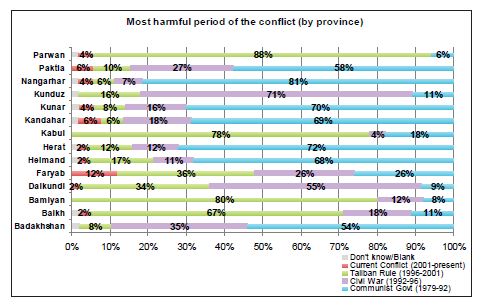
The International Committee of the Red Cross reported in 2009 that almost all Afghans – 96 percent – have been affected either directly or indirectly by warfare; more than one-third (35 percent) had a family member killed, 29 percent said they had been tortured, and a third (35 percent) had been wounded.


Around the same time, eight nongovernmental organizations operating in Afghanistan conducted research in 14 provinces to better understand how Afghans experienced and understood the past thirty years of conflict. The different phases of the war is captured in this quote.

“Wars have no difference. The mujahadeen killed my father and then the Taliban tortured and killed my brother. It is always the people who are suffering.” – Female, Daikundi

The top graph is from the ICRC report, the bottom from the cost of war.

Our World, Views From the Field
Afghanistan Opinion and In-Depth Research, 2009
International Committee of the Red Cross/Crescent

Afghanistan Experience with Conflict 1978 – 2009 | The Cost of War

Afghan Civil Society Forum (ACSF), Afghan Peace and Democracy Act (APDA), Association for the Defence of Women’s Rights (ADWR), Cooperation Centre for Afghanistan (CCA), Education Training Center for Poor Women and Girls of Afghanistan (ECW), Oxfam GB, Organization for Human Welfare (OHW), Sanayee Development Organization (SDO) and The Liaison Office (TLO).


The Alternatives


Despite displacement and exile, Afghans have maintained their political, cultural, and social identity, and family livelihoods through extensive networks of remittances. They possess the capacity to build their own country, but need assistance breaking the crippling dependency on spending related to the presence of international military and donor organizations. Consider: The World Bank finds that 97 percent of Afghanistan’s gross domestic product stems from those sectors.

That money comes at a cost.

The US and the international community put conditions and demands on how their money is spent. Pushing Afghan institutions in directions that are unsustainable and will insure more conflict and violence. Instead of creating a militarized state with a standing army costing an estimated $6 to 8 billion we could invest in and support sustainable institutions. For example, fully funding the government’s ambitious five-year strategic plan for the ministry of education would be $2.5 billion.

Until the US, the most powerful economic and military force in Afghanistan, embraces these goals, as well as a genuine peace process that includes all parties to the conflict, nascent Afghan institutions will never have a chance.

The $10 billion per month the US spends on the war in Afghanistan could make a very big difference in funding education, health care and other infrastructure needs both in Afghanistan and in our own country.

It's time to get the troops and weapons out.

Monday, October 3, 2011

Letter From Kabul | Witness to a ten-year war

I arrived in Kabul early in the morning on Saturday August 20 for my fourteenth annual visit since 2002. One is immediately struck by the militarization of the entire city, from the man who stamped my passport, to the heavily armed police presence at every street intersection. Check points, huge concrete blast walls, barbed wire on every official and foreign establishment, armed guards, soldiers and police are ever present.

We drove by the British Council, scene of a ten-hour battle between six suicide insurgents and the Afghan police assisted by the International Security Assistance Force (ISAF) the day before. The large building was completely flattened, with all the nearby windows shattered and debris all over. The Toyota van the insurgents had used to smash the metal gate by explosion was reduced to mangled pieces of metal and not recognizable as a car. This was one of a series of spectacular attacks and assassinations by the insurgents this year. It seems that they can attack anyone, any time, any place.

Zaher Wahab | 1 September 2011

Mural image from Windows and Mirrors: The Children of Afghanistan, by Camille Perrottet, New York, NY.


*****

Last night he sent me these thoughts on what life is like in Kabul today. It is an unvarnished account of the dangers an Afghan peacemaker sees emerging in the country. In June he sent a dispatch that looked at the rays of hope.


*****


Letter From Kabul | Witness to a ten-year war and occupation

Since early 2002, I have been spending at least a semester annually here in Afghanistan, attempting to (re)build the higher education system in the ravaged country. My adopted country - the US, launched operation Enduring Freedom on October 7/2001 claiming to bring freedom, peace, prosperity, democracy, security, women’s liberation, eradication of drugs, and stability to the war-torn country. There are now some 150/000 troops from 45 countries, that many civilian contractors from around the world, and 340,000 U.S. trained sectarian Afghan security forces all ostensibly fighting “terrorism”.

The US alone spends ten billion dollars per/ month on the war, a total of about half – a- trillion dollars in the last ten years. 1600 Americans (70 of them last August) have been killed and thousands wounded. An estimated 40,000 Afghans have been killed, 971 civilians from June to August this year alone, untold numbers wounded, and half–a-million displaced. According to a recent UN report, 2011 has been the most unstable, deadliest and most violent year for all sides, since the war started in 2001. All of the country’s neighbors also meddle in Afghan affairs and are waging proxy struggles in the Afghan theater.

After ten years of occupation (and “development”), costing the US $500 billion, Afghanistan still ranks at the bottom of the Human Development Index. Half of the population is hungry and/or food insecure. Per capita income is about $350. The average life span is 45 years. 90% of the women and 70% of the men are illiterate. Only half of the school age children attend school. More than half the schools have no building. Only 20% of the teachers are considered qualified. The Afghan government spends just $70 per year per student.

Americans spend one million dollars per year per soldier in Afghanistan. Just 1% of the age group is enrolled in college. UNICEF labeled the country as the worst place for children and women. A woman dies in child birth every hour. Half of the children die before age five. All marriages are arranged, and the majority of the girls are married (sold) off before age 16.

Ninety seven percent of the country’s $15 billion GDP and 97% of the government’s $4 billion budget are based on the presence of foreigners (armies, aid, NGOs, etc). There is little organized licit formal productive economy. Drugs constitute about a third of the economy and there are close to 2 million addicts. Half the people are (un)underemployed. Anyone who can is leavening the country. People have been divided, demoralized, and exhausted.

But since this is mostly a young nation so the prospects for an “Afghan Spring” are a real possibility.

The American installed and protected government has no legitimacy, credibility, authority, ability, will, or efficacy. It is essentially a dysfunctional plutocracy- mafiocracy with various crime syndicates and criminal gangs milking the foreigners and preying on the disempowered, divided and enraged public. The government cannot and will not provide the basic services like education, healthcare, work, security, justice, law and order, water, electricity, sewerage systems, garbage collection, clean air, roads or even traffic lights in the capital Kabul. The old and new criminal, treacherous, treasonous and sectarian warlords are empowered, paid, armed, legitimated, used and protected by the occupation forces at the expense of the wretched population. And the country’s very future is in question. Many express nostalgia about the monarchy, the communists, even the Taliban eras.

There has been no serious attempt either by the occupiers or their self-spring and corrupt client regime to build a functioning government, democracy, institutions, civil society, freedom, justice, national unity, long- term peace, real security, or stability.

The insurgents control about 70% of the country, including the outskirts of Kabul. They can hit anyone, any time, any place as demonstrated by the recent assassinations of A.W. Karzai, Daoud Dauod, Jan Mohammad a close adviser to president Karzai, the Kandahar mayor, the Kundoz governor, former warlord, former president and president of the so- called High Peace Council, B. Rabbani, the CIA employee, etc. The insurgent attacked the Intercontinental Hotel, the British Council, The US Embassy and the ISAF headquarters, and petrified and paralyzed Kabul for days. I have experienced four lockdowns, one lasting three days in the last six weeks. Kabul looks and feels like a garrison city under siege, but with no sense of security, legality, justice or normalcy.

The people despise, distrust and disdain the government, and the government has little to no concern, responsibility or respect for the people. Most Afghans hate, despise, and distrust all the foreigners and blame them for all the calamities visited upon the country. And the non Pashtoons fear and dislike the Taliban insurgents. The country is on the brink of a bloody civil war. But the one percent predatory warlords, criminals, and war profiteers love the foreigners, the war, and the “new freedom”. Anything goes, everything is negotiable, nothing matters, and people are disposable. There are governments within the government, cities within cities, and countries within the country. There is the war related contracting mafia, the land mafia, the timber mafia, the development mafia and the drug mafia, weapons smugglers, and human traffickers.

The occupiers work hand – in- gloves with the older and new known war criminals, human rights abusers, thieves and gangsters. This has widened the distance between the people and the colonial settler power and its local intermediaries. There is no clear boundary between the government the warlords and various crime syndicates, they are closely intertwined. All this explains the success of the insurgency, the moral-political-military disarray of the US/NATO invaders in the country, and the stalemate if not success of the insurgents in the war. In short, life has become much harder for the vast majority of Afghans. Who still lead primitive lives.

Additionally, they endure a brutal occupation with heavy use of storm troops, air power, drones, night raids, and the mercenary Afghan regular and irregular armies. And now there is open talk of resurgent civil war. Mr. Rabbani’s assassination has ruptured the so-called “peace talks.” The US/NATO, while talking about withdrawal is also pressing for a permanent “strategic agreement” with Kabul. There is great confusion, fear, anxiety, and uncertainty in the country. No wonder then, those who can, are leaving, with the rest preparing for the worst.

Only a miracle can save the people and the country.

Zaher Wahab | 2 October 2011
Afghanistan 101 is a blog of the American Friends Service Committee
215-241-7000 · web@afsc.org